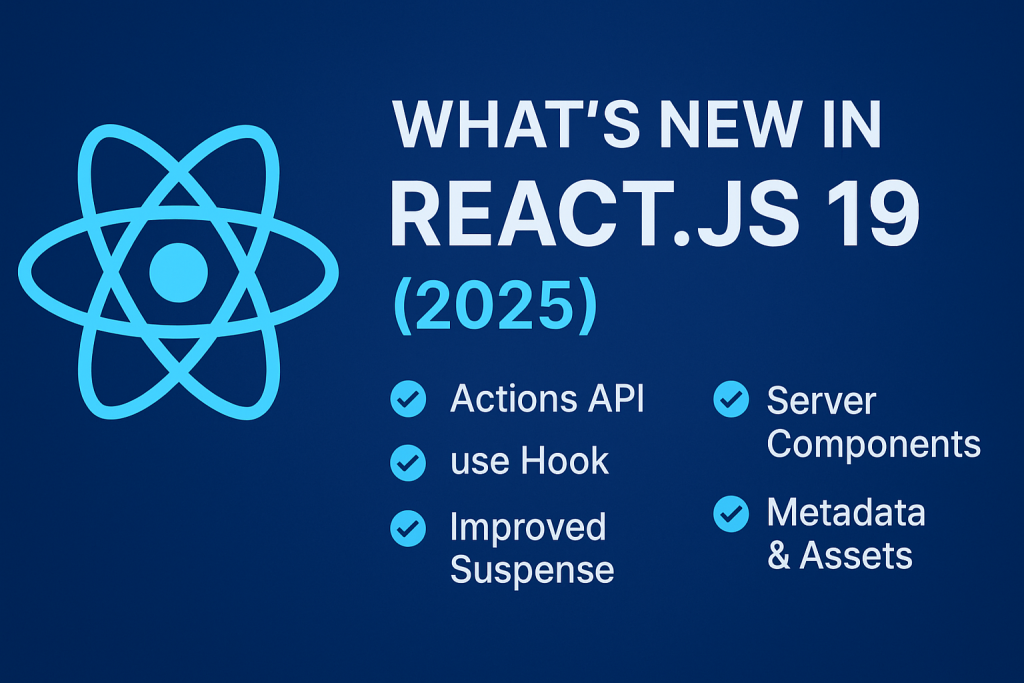
New in React.js 2025 continues to lead the modern web development ecosystem. With the release of React 19 (December 2024), developers now have access to powerful tools for async workflows, server rendering, and performance optimization.
🔑 What’s New in React 19?
1. Actions API – Simplified Async Workflows
React 19 introduces Actions for handling form submissions, async requests, and error states automatically.
import { useOptimistic, useActionState } from 'react';

function NewsletterForm() {
  const [email, setEmail] = useOptimistic('', (draft, newEmail) => newEmail);
  const [state, submitAction] = useActionState();

  async function handleSubmit(e) {
    e.preventDefault();
    await submitAction(async () => {
      await subscribeToNewsletter(email);
    });
  }

  return (
    <form onSubmit={handleSubmit}>
      <input
        value={email}
        onChange={(e) => setEmail(e.target.value)}
        disabled={state.isPending}
      />
      <button type="submit" disabled={state.isPending}>
        {state.isPending ? 'Subscribing…' : 'Subscribe'}
      </button>
      {state.error && <span>Error: {state.error.message}</span>}
    </form>
  );
}
👉 No more manual state handling—React manages loading, errors, and optimistic updates.
2. The use Hook – Async Data Made Easy
Instead of useEffect + useState, React 19 allows direct promise handling.
import { use } from 'react';

function PostsList() {
  const posts = use(fetchPosts());
  return (
    <ul>
      {posts.map(post => <li key={post.id}>{post.title}</li>)}
    </ul>
  );
}

async function fetchPosts() {
  const res = await fetch('/api/posts');
  return res.json();
}
👉 Works seamlessly with Suspense for loading states.
3. Server Components & Actions
Server Components reduce bundle size by running logic on the server.
// UserProfile.server.jsx
export default async function UserProfile({ userId }) {
  const user = await getUserFromDb(userId);
  return <h2>Welcome, {user.name} 👋</h2>;
}
👉 Less JS sent to the client → faster apps.
4. React Compiler (Production Ready)
The new compiler optimizes code at build time, automatically removing unnecessary re-renders and making apps faster without extra effort.
5. Improved Suspense
Better integration with async data fetching.
<Suspense fallback={<p>Loading...</p>}>
  <PostsList />
</Suspense>
👉 Combine use + Suspense for clean async UIs.
6. Metadata & Assets Management
React 19 supports titles, meta tags, stylesheets, and scripts natively.
import { Helmet } from 'react-helmet';

function Page() {
  return (
    <>
      <Helmet>
        <title>React 19 Blog</title>
        <meta name="description" content="New React 19 features" />
      </Helmet>
      <h1>Welcome to React 19 🚀</h1>
    </>
  );
}
🔄 Migration: React 18 → 19
- ✅ Use codemods to update deprecated APIs
- ✅ Replace old async logic with Actions API
- ✅ Gradually adopt Server Components
- ✅ Test for third-party library compatibility
👉 Official Guide: React 19 Upgrade Guide
❓ React 19 FAQs
Yes ✅ React 19 is officially stable and production-ready as of December 2024.
Actions API + new hooks (useActionState, useOptimistic) and the React Compiler.
No ❌ Migration is smooth with codemods. Most existing React 18 apps need only small adjustments.
No ❌ React 19 adds Server Components, but frameworks like Next.js still handle routing, bundling, and deployment.
Yes ✅ It’s the recommended version moving forward.
Final Thoughts
React 19 isn’t just an update—it’s a new way of thinking about async workflows and performance.
- 🔥 Cleaner async logic with Actions
- ⚡ Faster apps with Server Components & Compiler
- 🎨 Better developer experience with hooks & Suspense
If you’re starting a project in 2025 → React.js 2025 is the future.