
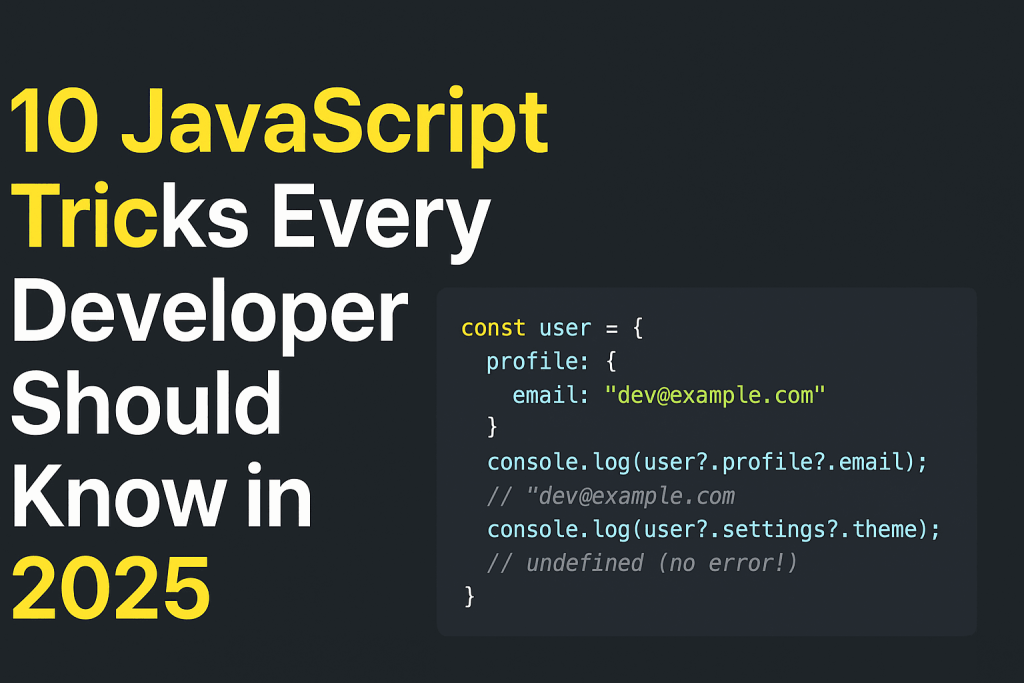
JavaScript has come a long way since its early days. In 2025, it’s still the backbone of web development—powering everything from simple websites to complex web apps, Next.js projects, and AI integrations. Whether you’re a beginner or a seasoned developer, knowing some smart tricks can save you hours of work and make your code cleaner, faster, and easier to maintain. In this article, we’ll explore 10 powerful JavaScript tricks that will level up your skills in 2025.
1. Use Optional Chaining (?.) to Avoid Errors
Optional chaining helps prevent “cannot read property of undefined” errors.
const user = {
  profile: {
    email: "dev@example.com"
  }
};

console.log(user?.profile?.email); // "dev@example.com"
console.log(user?.settings?.theme); // undefined (no error!)
👉 Perfect for working with API responses where data may or may not exist.
2. Nullish Coalescing Operator (??)
Use ?? to set a default value only when the variable is null or undefined (not when it’s 0 or false).
let count = 0;
console.log(count ?? 10); // 0 (not 10)
This is better than || for numbers and booleans.
3. Destructuring for Cleaner Code
Instead of writing repetitive property access, use destructuring.
const user = { name: "Pradeep", role: "Developer" };

const { name, role } = user;
console.log(name, role); // "Pradeep Developer"
👉 Great for working with React props or API data.
4. Short-Circuit Evaluation
Use && and || for quick conditionals.
const isLoggedIn = true;
isLoggedIn && console.log("Welcome back!"); // Prints message
5. Template Literals for Dynamic Strings
Forget string concatenation—use backticks.
const name = "JavaScript";
console.log(`Hello, ${name}! Welcome to 2025 🚀`);
6. Array Methods Like map(), filter(), and reduce()
These methods make loops cleaner and more functional.
const numbers = [1, 2, 3, 4, 5];
const doubled = numbers.map(n => n * 2);
console.log(doubled); // [2, 4, 6, 8, 10]
7. Use fetch() with async/await
Modern APIs require clean async handling.
async function getData() {
  try {
    const response = await fetch("https://jsonplaceholder.typicode.com/posts/1");
    const data = await response.json();
    console.log(data);
  } catch (error) {
    console.error("Error:", error);
  }
}

getData();
8. Debouncing and Throttling for Performance
Great for search inputs and scroll events.
let timer;
function debounce(func, delay) {
  return function(...args) {
    clearTimeout(timer);
    timer = setTimeout(() => func.apply(this, args), delay);
  };
}

window.addEventListener("resize", debounce(() => {
  console.log("Window resized!");
}, 500));
9. Copy Objects with Spread Operator
Instead of Object.assign(), use spread for cleaner code.
const user = { name: "Pradeep", role: "Dev" };
const updatedUser = { ...user, role: "Full Stack Dev" };
console.log(updatedUser);
10. Modern ES Modules (Import/Export)
In 2025, ES Modules are the standard.
// utils.js
export const greet = name => `Hello, ${name}!`;

// main.js
import { greet } from "./utils.js";
console.log(greet("Pradeep"));
Final Thoughts
JavaScript is evolving constantly. By mastering these 10 JavaScript tricks, you’ll write cleaner, faster, and more maintainable code. Whether you’re working on a Next.js app, a Node.js backend, or a WordPress theme with custom scripts, these techniques will give you a solid edge as a developer in 2025.
