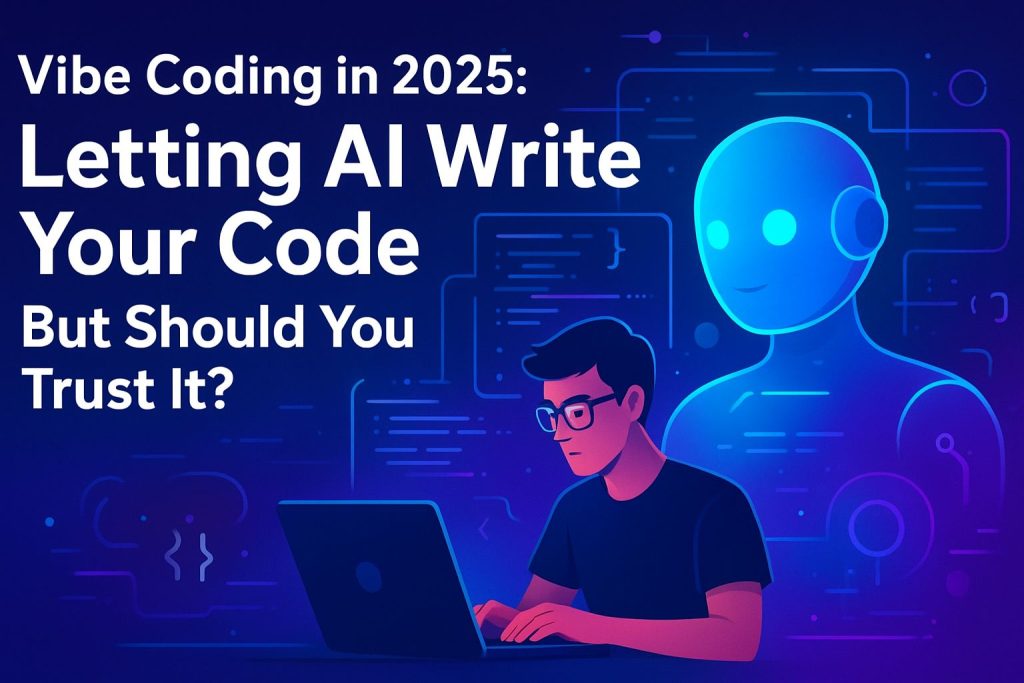
Software development is changing at lightning speed. Just a few years ago, coding meant long hours at the keyboard, typing every line of logic manually. In 2025, however, a new trend has entered the developer world: Vibe Coding—a style of programming where AI does most of the work, and the developer focuses on guiding it through natural language prompts.
Coined by Andrej Karpathy (former Tesla AI director and OpenAI co-founder), “vibe coding” refers to a development process that feels less like strict coding and more like conversational experimentation with an AI partner. It’s fast, fluid, and sometimes magical. But like any breakthrough, it comes with risks.
So, what exactly is vibe coding, why is it trending, and should developers fully embrace it? Let’s dive deep.
🧑💻 1. What Is Vibe Coding?
Vibe coding is the practice of using AI tools to generate, refactor, and maintain code with minimal manual typing. Instead of writing every function yourself, you tell the AI what you need, and it generates code instantly.
Examples of vibe coding in action:
- Asking AI: “Build a login system with JWT authentication in Node.js” → AI outputs working code.
- Prompting AI: “Optimize this React component for performance” → AI rewrites it efficiently.
- Saying: “Add dark mode support to my CSS” → AI generates and integrates the styles.
👉 In short, vibe coding feels like “coding without coding”—more about giving directions than writing syntax.
🌍 2. Why Vibe Coding Is Trending in 2025
Several factors have made vibe coding the hot topic of today:
🔹 AI Maturity
With tools like GitHub Copilot, ChatGPT, and advanced coding agents, AI is now smart enough to produce production-grade code.
🔹 Speed of Development
Startups are reporting that 95% of their codebases are AI-generated, massively reducing development timelines.
🔹 Accessibility
Non-developers and beginners can now build apps by simply describing features, making coding more inclusive and democratized.
🔹 Industry Shift
Tech leaders like the GitHub CEO have openly said: “Developers must embrace AI or risk falling behind.”
👉 The result: vibe coding is no longer niche—it’s becoming mainstream.
📌 3. Benefits of Vibe Coding
Like any disruptive trend, vibe coding brings undeniable advantages:
✅ 1. Faster Prototyping
Ideas that used to take weeks can now be turned into prototypes in hours.
✅ 2. Lower Barrier to Entry
Beginners can focus on learning concepts instead of getting stuck on syntax errors.
✅ 3. Enhanced Productivity
Developers spend more time designing solutions and less time on repetitive tasks.
✅ 4. Collaboration with AI
AI can act as a pair programmer, suggesting improvements, spotting bugs, and generating tests.
✅ 5. Expanding Creativity
Since AI can generate multiple variations of a solution, developers can explore more options quickly.
⚠️ 4. Risks and Downsides of Vibe Coding
However, relying heavily on AI also has serious challenges:
❌ 1. Lack of Understanding
If developers don’t know how the AI-generated code works, debugging becomes a nightmare.
❌ 2. Code Quality Concerns
AI-generated code might work, but it may not follow best practices or be optimized for scalability.
❌ 3. Security Vulnerabilities
AI can unintentionally introduce unsafe code, creating security risks.
❌ 4. Over-Reliance on AI
Developers risk losing core problem-solving skills if they let AI handle everything.
❌ 5. Technical Debt
Quick fixes from AI may lead to long-term maintenance problems if not reviewed carefully.
👉 This is why experts say: AI can write code, but developers must still review, refactor, and understand it.
🚀 5. How Vibe Coding Fits in the 2025 Developer Workflow
In 2025, vibe coding isn’t replacing traditional coding—it’s reshaping it. Developers now work in three layers:
- Prompt Layer → Describing tasks to AI (“Build a REST API in Express.js”).
- Review Layer → Reading and testing the AI’s output.
- Refactor Layer → Improving the code for quality, scalability, and security.
Instead of writing 100% of the code, developers may write 20–30% manually, while AI generates the rest.
👉 The skill of the future: knowing how to guide AI effectively while still being able to code independently when needed.
🔑 6. Best Practices for Safe Vibe Coding
If you want to use vibe coding effectively, follow these tips:
- Always Review AI Code → Don’t copy-paste blindly; check for logic and security issues.
- Understand Before You Deploy → If you can’t explain the code, don’t push it to production.
- Use AI for Boilerplate → Let AI handle repetitive tasks, while you focus on core logic.
- Combine AI with Testing → Write unit tests to ensure AI-generated code works correctly.
- Stay Updated → Keep learning programming fundamentals, even if AI handles much of the work.
👉 Remember: AI is a tool, not a replacement for developer responsibility.
📂 7. Real-World Examples of Vibe Coding
Startups → Building MVPs in record time using AI-first workflows.
- Enterprises → Automating repetitive code tasks while engineers focus on architecture.
- Freelancers → Delivering projects faster, increasing income potential.
- Students → Building projects with AI while learning the underlying concepts.
🤖 8. The Future of Vibe Coding
The big question: Will vibe coding replace developers?
The answer: No—but it will replace developers who don’t adapt.
- Developers who embrace vibe coding will become AI copilots, leading projects with speed and efficiency.
- Those who resist may find themselves falling behind in a world where AI-first workflows are the norm.
- In the long run, vibe coding may lead to hybrid development: humans focusing on design, ethics, and critical problem-solving, while AI handles repetitive or low-level tasks.
👉 In other words: Developers won’t disappear—they’ll evolve.
🎯 Final Thoughts
Vibe coding is more than just a buzzword—it represents a paradigm shift in software development. In 2025, AI has become a powerful collaborator, capable of generating most of a project’s codebase.
But with this power comes responsibility. Developers must balance speed with caution, convenience with security, and AI assistance with human expertise.