
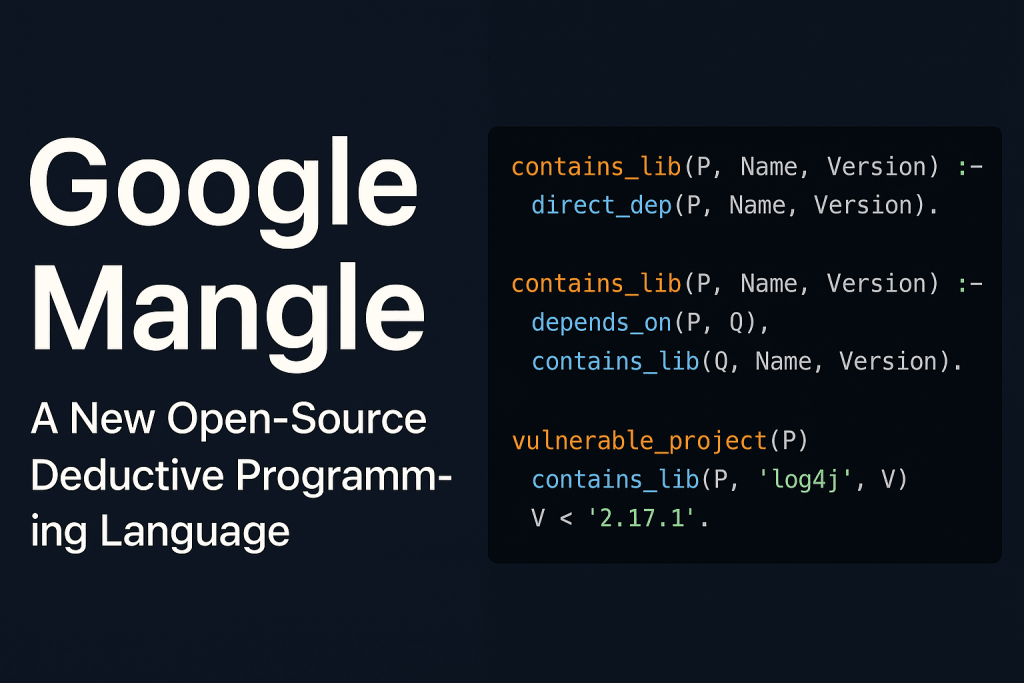
Mangle is an open-source programming language released by Google on August 22, 2025, designed to bring the power of deductive logic (like Datalog) to real-world data reasoning challenges.
At its core, Mangle extends Datalog—a declarative logic language known for recursive rules and database queries—with modern, practical features that make it far more usable in today’s fragmented data world.
Motivation: Why Mangle Matters
Organizations today often suffer from data that’s scattered across logs, APIs, databases, files, and services. Traditional tools struggle to reason over such heterogeneity cleanly.
Mangle’s promise is to unify disparate data sources into a logical, queryable database, enabling seamless analysis across contexts—vulnerability detection, dependency tracking, knowledge graph reasoning, and more TechGig.
Key Features of Mangle
1. Recursive Rules
- Supports logic like „project contains a vulnerable library either directly or via dependencies“.
- This allows recursive definitions, such as:
contains_jar(P, Name, Version) :- contains_jar_directly(P, Name, Version). contains_jar(P, Name, Version) :- project_depends(P, Q), contains_jar(Q, Name, Version).GitHub.
2. Uniform Data Access
- Views facts from multiple origins (file systems, APIs, DBs) as a single unified knowledge base.
- This simplifies querying without having to wrangle data ingestion or transformations TechGig.
3. Aggregation & Function Calls
- Supports grouping and aggregation with syntax like:
count_projects_with_vulnerable_log4j(Num) :- projects_with_vulnerable_log4j(P) |> do fn:group_by(), let Num = fn:Count(). - Additionally, function calls enable computations—for example, sums, counts, or even custom logic GitHub.
4. Developer-Friendly Syntax & Embeddable Library
- Built as a lightweight Go library, Mangle is easy to embed directly into tools like security scanners, SBOM analyzers, or infrastructure policy engines TechGig.
- Aims to be accessible to developers unfamiliar with classical logic programming paradigms TechGig.
Releases & Project Status
Mangle has seen orderly development progression:
- v0.1.0 – First tagged release (Dec 16, 2024), marking a usable baseline GitHub.
- v0.2.0 – Released on August 14, 2025; added lattice support, bug fixes, improved docs, and the interpreter
mgGitHub. - v0.3.0 – Released May 21, 2025; introduced
.Type<>syntax, a special arrow syntax (⟸) for rules, and additional functions GitHub.
Notably, it is not an officially supported Google product, but rather a community-oriented effort, albeit backed by Google engineers GitHubHacker News.
Community Reaction
On Hacker News, the response to Mangle has been a mix of enthusiasm and thoughtful skepticism:
“Anybody who replaces the hoary old albatross of SQL without throwing out the relational algebra baby with the bathwater gets my support.”
“Syntax not, but datalog (-ish) does. It’s a more natural way… Far more complex queries with less mental overload.”
Hacker News
There’s also curiosity about its position in Google’s ecosystem, with speculation about multiple logic query languages emerging from different teams Hacker News.
Why It’s Worth Your Attention
- Unified reasoning over fragmented systems
Great for security, dependency management, knowledge graphs. - Logical yet practical
Combines Datalog’s declarative power with real-world extensions like aggregation, functions, and embedded use. - Lightweight and embeddable
Written in Go, easily integrates into tools and workflows. - Open source with collaborative potential
Community contributions welcomed, with the potential to evolve into a solid logic query platform GitHub+1.
Who Should Care?
- Security engineers – Detect issues across SBOMs, vulnerable libraries, policy enforcement.
- DevOps/SREs – Trace infrastructure dependencies, access paths, and configurations.
- Knowledge engineers – Model complex entities and relationships without being bound to binary predicates.
- Data platform developers – Integrate logical querying into tools without external dependencies.
Sample Use Case
For example, to catch projects with vulnerable Log4j versions, you can define:
projects_with_vulnerable_log4j(P) :-
  projects(P),
  contains_jar(P, "log4j", Version),
  Version != "2.17.1",
  Version != "2.12.4",
  Version != "2.3.2".
Then count them:
count_projects_with_vulnerable_log4j(Num) :-
  projects_with_vulnerable_log4j(P) |> do fn:group_by(), let Num = fn:Count().
Or include recursive dependency tracing via contains_jar definitions—showing how elegantly Mangle handles logic flows from simple to recursive queries GitHub.
| Feature | Mangle | SQL | Datalog | Prolog | GraphQL |
|---|---|---|---|---|---|
| Recursive queries | ✅ Native & simple | ⚠️ Possible via recursive CTEs but clunky | ✅ Native | ✅ Native | ❌ Not supported |
| Aggregation | ✅ Built-in (fn:Count(), etc.) | ✅ Strong | ⚠️ Limited in classical Datalog | ⚠️ Requires workarounds | ✅ Strong |
| Embeddability | ✅ Lightweight Go lib | ❌ Heavy RDBMS needed | ⚠️ Theoretical, limited tooling | ⚠️ Full Prolog runtime required | ❌ Requires a GraphQL server |
| Data Source Flexibility | ✅ Works across APIs, files, DBs | ⚠️ SQL DB only | ⚠️ Usually DB only | ⚠️ In-memory KB | ⚠️ Works across APIs but no recursion |
| Learning Curve | Medium | Low | Medium | High | Low |
| Use Cases | Security, infra, SBOM, reasoning | Reporting, BI | Academic reasoning | AI/logic programming | API querying |
Conclusion
Google’s Mangle emerges as a promising tool to fuse the declarative elegance of logic programming with practical developer needs for handling complex and distributed data. It’s light, embeddable, and already evolving—with a growing set of features and active community interest.
If you’re wrestling with fractured systems, dependency complexity, or want a more natural way to express logic queries, Mangle is definitely worth exploring.
References:
- Initial announcement and feature overview: TechGig
- GitHub README and design rationale: GitHub
- Release chronology (v0.1.0 to v0.3.0): GitHub
- Community feedback: Hacker News

