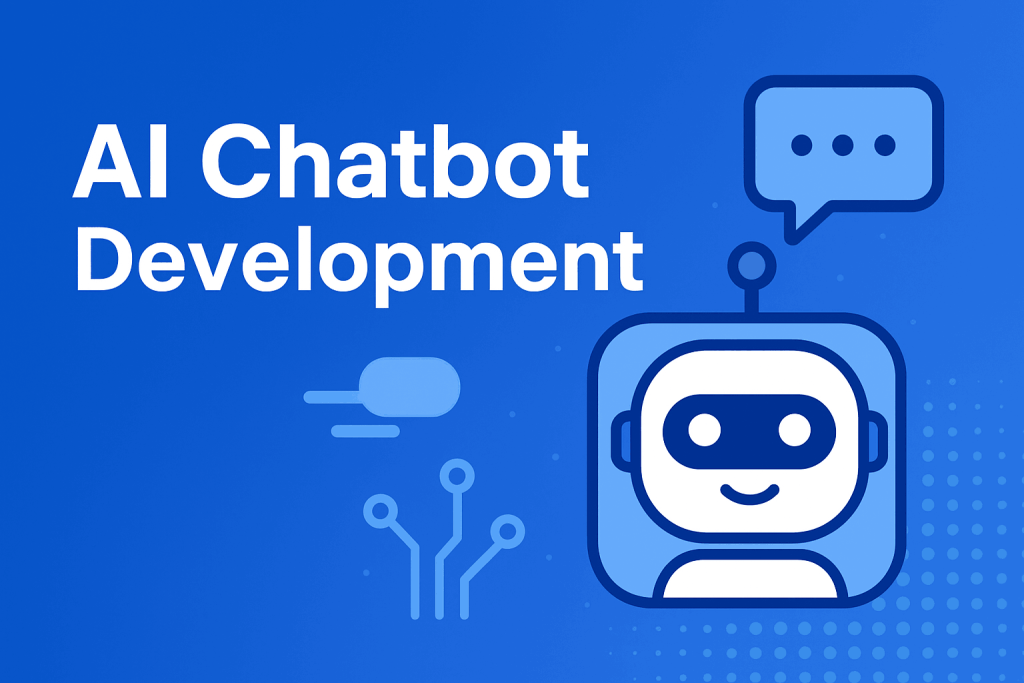
AI Chatbot Development: A Complete Guide – In the current digital-first era, AI chatbots are revolutionizing the way businesses communicate with customers, automate tasks, and offer support services 24/7. From basic FAQ chatbots to sophisticated conversational AI such as ChatGPT, the development of AI-powered conversations has changed the face of customer experience and business efficiency.
In this blog, we will take a closer look at the development of AI chatbots, what it entails, its significance, the technology used, and how you can develop one for your business.
What is AI Chatbot Development?
AI chatbot development is the process of designing, developing, and deploying conversational interfaces that can communicate with users in a natural way, either through text or speech. Unlike traditional rule-based chatbots, AI chatbots use Natural Language Processing (NLP) and Machine Learning (ML) to have a more human-like conversation.
In short, the development of AI chatbots is the process of integrating software development, AI models, and user experience design to develop a digital assistant that can think, learn, and respond in a smart way.
Why Businesses Need AI Chatbots
- 24/7 Customer Support – Bots don’t sleep. Customers get instant answers anytime.
- Cost Efficiency – It reduces the reliance on a large human support team.
- Personalized Experience – AI-powered chatbots are able to provide personalized responses based on data.
- Scalability – Process thousands of conversations at the same time without any lag.
- Lead Generation & Sales – Bots qualify leads, schedule appointments, and even make sales.
According to reports, 80% of businesses will use chatbots for customer interactions by 2030, making them a key driver of digital transformation.
Types of AI Chatbots
Not all chatbots are the same. Here are the main categories:
1. Rule-Based Chatbots
- Work on pre-defined scripts or decision trees.
- Limited intelligence, best for FAQs.
2. AI-Powered Chatbots
- Use NLP and ML to understand queries.
- Can improve over time by learning from interactions.
3. Voice-Enabled Chatbots
- Integrated with speech recognition (e.g., Alexa, Google Assistant).
- Useful for industries like healthcare, automotive, and smart homes.
4. Hybrid Chatbots
- Combine rule-based flow with AI.
- Balance speed, reliability, and intelligence.
Key Technologies Behind AI Chatbot Development
- Natural Language Processing (NLP)
- Enables bots to understand and generate human language.
- Examples: spaCy, NLTK, GPT models.
- Machine Learning (ML)
- Helps chatbots improve by learning from data and user interactions.
- Speech Recognition & Synthesis
- Converts spoken language into text and vice versa.
- Examples: Google Speech-to-Text, Amazon Polly.
- APIs & Integrations
- Connect chatbots with CRMs, databases, or third-party apps for extended functionality.
- Cloud Platforms
- AWS Lex, Microsoft Bot Framework, Google Dialogflow simplify chatbot deployment.
Steps to Develop an AI Chatbot
Here’s a step-by-step roadmap for AI chatbot development:
1. Define Objectives
- What problem will your chatbot solve?
- Example: Customer support, sales assistant, HR helpdesk.
2. Choose the Right Platform/Framework
- Popular choices:
- Dialogflow (Google)
- Rasa (Open-source)
- Microsoft Bot Framework
- IBM Watson Assistant
3. Design Conversation Flow
- Use storyboards or flowcharts to map out conversations.
- Include fallback messages when the bot doesn’t understand.
4. Train NLP Model
- Collect data (FAQs, chat logs, support tickets).
- Train your model to recognize intents and entities.
5. Integrate APIs & Databases
- Connect chatbot to CRM, payment gateway, or knowledge base.
6. Test and Refine
- Test across multiple scenarios.
- Collect feedback and optimize responses.
7. Deploy and Monitor
- Deploy on website, mobile app, or social platforms (WhatsApp, Messenger, Slack).
- Use analytics to track engagement, satisfaction, and conversion.
Best Practices in AI Chatbot Development
- Start Simple, Scale Gradually – Launch with core features, then expand.
- Human Handoff – Always provide an option to connect to a human agent.
- Personalization – Use customer data to deliver context-aware responses.
- Continuous Training – Keep improving chatbot knowledge with new data.
- Security & Compliance – Ensure GDPR and data privacy compliance.
Real-World Use Cases of AI Chatbots
- E-commerce: Product recommendations, order tracking, cart recovery.
- Banking & Finance: Balance inquiries, fraud alerts, loan processing.
- Healthcare: Appointment booking, symptom checker, medication reminders.
- Travel & Hospitality: Flight booking, hotel check-ins, travel assistance.
- Education: Student queries, course guidance, interactive learning bots.
Future of AI Chatbot Development
The next phase of AI chatbots is conversational AI 2.0, powered by:
- Generative AI (GPT models, LLaMA, Claude) for natural dialogues.
- Multimodal bots (text + voice + image input/output).
- Emotional AI to detect user sentiment and adjust tone.
- Integration with IoT for smart homes, cars, and wearables.
By 2035, AI chatbots will evolve from assistants to true digital companions capable of decision-making and predictive interactions.
Conclusion
Developing an AI chatbot has become a necessity, rather than a choice, for businesses that aim to remain competitive in the market and provide the best possible customer service experience while cutting costs. Whether it is a simple FAQ bot or an advanced conversational AI assistant, the key to success lies in having the right goals and technology.
With the advancements in AI technology, chatbots will continue to reshape the manner in which we communicate, interact, and conduct business.