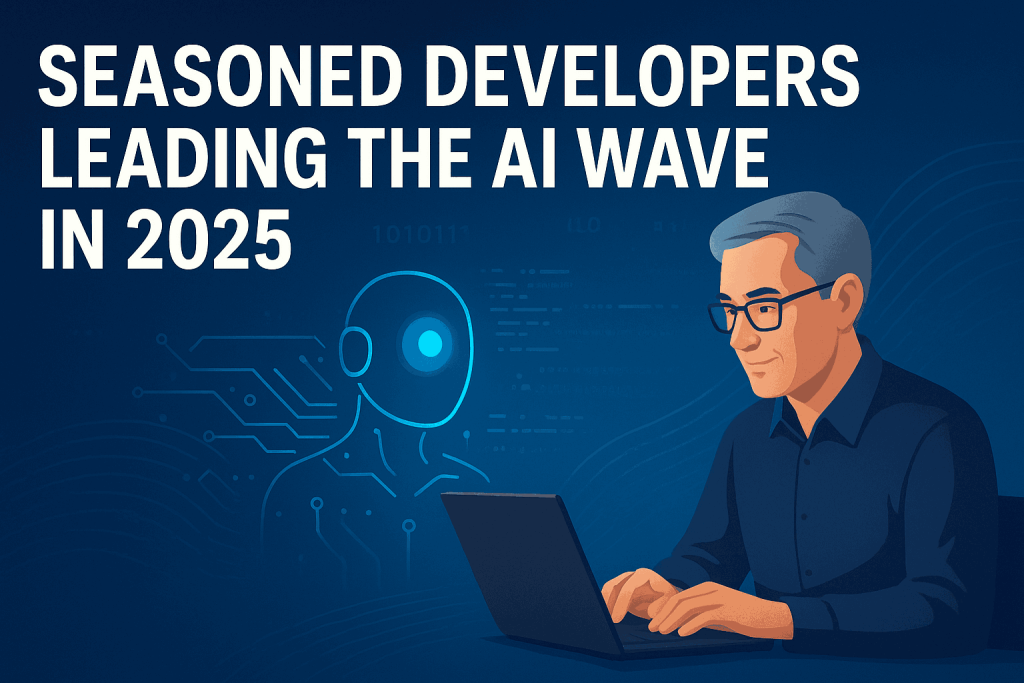
For years, the tech industry has often celebrated young, fast-moving developers as the face of innovation. Yet in 2025, a surprising trend is emerging: seasoned developers—the ones with decades of coding experience—are leading the AI revolution.
Contrary to the stereotype that older engineers resist change, research shows that they are not only adopting AI coding assistants but also using them more effectively than their younger counterparts. The rise of Agentic AI and vibe coding has revealed that experience, context, and critical thinking are now more valuable than raw speed.
So, why are veteran developers becoming the champions of the AI wave? Let’s dive in.
1. Shattering the Stereotype
The tech world has long carried a bias that “older coders can’t keep up.” Stories of twenty-something prodigies founding startups and building viral apps reinforced the idea that innovation belongs to the young.
But in 2025, data tells a different story:
- Seasoned developers are embracing AI assistants like GitHub Copilot, ChatGPT, and Tabnine at higher adoption rates than juniors.
- Their productivity gains are greater, as they know how to critically evaluate and refine AI outputs.
- Companies are recognizing that years of domain expertise combined with AI tools deliver far more reliable results.
This shift marks the end of the “tech youth obsession” and the beginning of a more balanced view of developer value.
2. Why Experienced Developers Excel with AI
1. Contextual Understanding
AI coding assistants are great at generating code—but not always at understanding why that code matters. Experienced developers can quickly spot when AI produces technically correct but practically useless solutions.
2. Pattern Recognition from Experience
Decades of debugging, system design, and architecture work give veteran developers an intuitive sense for what will break and what will scale. This ability complements AI, which lacks real-world intuition.
3. Better Code Review Practices
Where younger developers may copy-paste AI output, seasoned developers treat AI as a junior collaborator—reviewing, optimizing, and polishing the code for maintainability and security.
4. Risk Awareness
AI can generate solutions that seem fine on the surface but introduce long-term technical debt or vulnerabilities. Experienced developers know when to pause, question, and adjust.
In other words: AI speeds up the process, but wisdom ensures it’s done right.
3. The New Role of Seasoned Developers
AI is not replacing developers—it’s reshaping their responsibilities. For seasoned professionals, that means:
- Mentorship at Scale → With AI handling repetitive coding, senior engineers guide teams in strategy, architecture, and ethical usage.
- AI Managers → Veterans oversee multiple AI agents, reviewing their outputs and integrating them into larger systems.
- Quality Guardians → They ensure AI-generated code is clean, secure, and future-proof.
- Ethics & Compliance Leaders → Their maturity makes them natural leaders in ensuring AI aligns with safety and compliance standards.
Instead of competing with AI, seasoned developers are collaborating with it.
4. Real-World Examples
Case 1: Legacy System Modernization
A team of veteran Java developers used AI to refactor a 20-year-old codebase. While AI handled the syntax updates, seasoned engineers ensured the business logic and security protocols remained intact.
Case 2: Cloud Migration
In a major enterprise shift to the cloud, AI tools automated configurations—but it was senior DevOps engineers who identified gaps in scalability and compliance, saving millions in potential downtime.
Case 3: AI-First Startups
Startups leveraging AI coding assistants often keep seasoned developers as technical anchors, ensuring that rapid AI-driven development doesn’t collapse under weak foundations.
5. The Productivity Gap
Studies in 2025 show that:
- Junior developers see ~30% productivity boosts with AI.
- Senior developers see up to 50–60% productivity boosts, because they use AI strategically rather than blindly.
This gap reinforces the value of experience in an AI-driven industry. Companies aren’t just hiring coders—they’re hiring judgment.
6. Challenges Seasoned Developers Still Face
While older engineers are leading the AI wave, challenges remain:
- Skill Refresh → AI evolves fast, requiring ongoing learning.
- Over-Reliance on AI → Risk of letting AI take over too much without oversight.
- Generational Collaboration → Bridging the mindset gap between younger “move fast” coders and experienced “think first” coders.
The good news? These challenges are solvable with continuous training and hybrid team structures.
7. Best Practices for Seasoned Developers in the AI Era
- Stay Curious → Experiment with new AI tools instead of resisting change.
- Leverage Mentorship → Use AI to free up time for mentoring younger devs.
- Focus on High-Level Strategy → Leave routine tasks to AI, concentrate on architecture and systems.
- Adopt AI Ethics as a Core Skill → Be the voice of responsibility in AI-driven projects.
- Collaborate Cross-Generationally → Blend experience with the fresh perspectives of younger developers.
8. The Future: Wisdom + AI
The real takeaway for 2025 is clear:
- AI coding assistants are not replacements for developers.
- Experience multiplies the value of AI.
- The most powerful teams are those where seasoned developers lead the AI wave—balancing speed, safety, and strategy.
Instead of making older developers irrelevant, AI is making them more valuable than ever.
Final Thoughts
The rise of Agentic AI and vibe coding has turned developer culture upside down. While younger coders may adapt quickly, it’s the seasoned developers who are emerging as leaders of this new AI era.
Their context, critical thinking, and risk management skills are exactly what AI lacks—and exactly what modern software development needs.
In 2025, the message is clear: wisdom scales with AI. Far from being left behind, experienced developers are the ones pushing the industry forward.