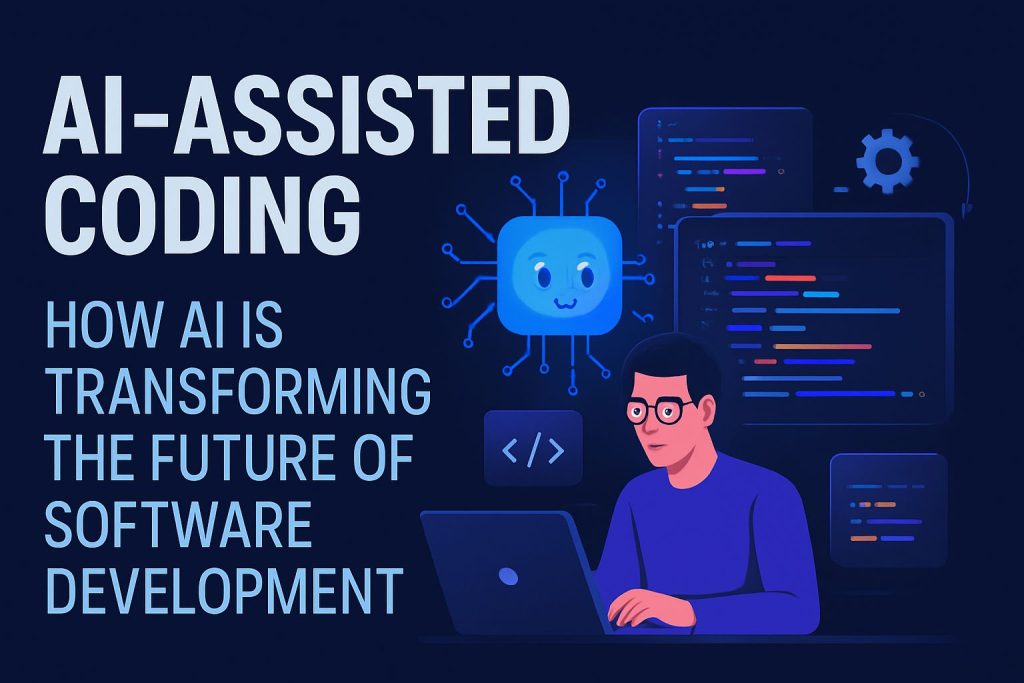
AI-assisted coding future of software development: Artificial Intelligence (AI) is no longer just a buzzword—it has become an everyday tool for developers. From writing boilerplate code to optimizing complex algorithms, AI-assisted coding tools like GitHub Copilot, ChatGPT, and Cursor IDE are changing the way software is built. This trend, often called AI-first coding, means developers are moving from manual code writing to AI-augmented development workflows.
In this blog, we’ll explore:
- What AI-assisted coding means
- How AI coding tools work
- Benefits and challenges of AI-first coding
- Popular AI tools for developers in 2025
- The future of software development with AI
What is AI-Assisted Coding?
AI-assisted coding refers to the use of artificial intelligence tools that generate, suggest, or optimize code. Instead of writing every line manually, developers can:
- Get real-time code suggestions inside their IDE
- Use AI to debug and refactor code
- Auto-generate tests, documentation, and boilerplate
- Quickly learn new frameworks and languages
This does not mean developers are being replaced. Instead, AI acts like a co-pilot, speeding up development and reducing repetitive tasks.
How Do AI Coding Tools Work?
Most AI-assisted coding platforms are built on Large Language Models (LLMs) trained on billions of lines of public code. These models learn syntax, logic patterns, and best practices.
Here’s how it works step by step:
- Context Capture → The AI looks at the current code you’re writing.
- Prediction → It predicts the most likely next line or block of code.
- Adaptation → The AI adapts based on programming language, libraries, and frameworks.
- Learning → Some tools improve with feedback, making future suggestions more accurate.
For example, in Visual Studio Code with GitHub Copilot, typing function fetchUserData might instantly suggest the API call, error handling, and return structure.
Benefits of AI-Assisted Coding
1. Faster Development
AI reduces time spent on repetitive code, setup, and boilerplate. Developers can move from idea → prototype in hours instead of days.
2. Fewer Bugs
AI models trained on best practices help detect common mistakes early. Some tools also highlight vulnerabilities and suggest secure alternatives.
3. Easier Learning for Beginners
New developers can use AI like an interactive tutor. Instead of Googling syntax errors, they get instant explanations.
4. Better Productivity for Teams
With AI handling routine coding, teams can focus more on architecture, problem-solving, and creativity.
5. Smarter Code Reviews
AI can analyze pull requests, suggest improvements, and reduce reviewer workload.
Challenges of AI-First Coding
While AI coding tools are powerful, they’re not perfect.
- Over-Reliance – Developers may copy suggestions blindly without understanding.
- Code Quality – AI sometimes generates inefficient or insecure code.
- Intellectual Property – Using AI-generated code raises copyright questions.
- Bias in Training Data – Since AI is trained on public code, it may reproduce poor coding patterns.
- Lack of Context – AI can’t fully understand business logic, so human oversight is essential.
Popular AI Coding Tools in 2025
Here are some of the most widely used and trending AI coding assistants:
GitHub Copilot
- Integrated directly into VS Code, Neovim, and JetBrains
- Trained on GitHub’s massive codebase
- Suggests entire functions, not just single lines
Cursor IDE
- An AI-first IDE gaining popularity
- Offers chat-based debugging, auto-refactoring, and context-aware completions
- Built for developers who want deep AI integration
OpenAI’s ChatGPT (Code Interpreter)
- Helps generate scripts, explain errors, and optimize code
- Can be integrated with terminals or dev workflows
- Useful for learning new frameworks like Next.js, Angular, or React
Amazon CodeWhisperer
- Free for individual developers
- Provides real-time suggestions
- Optimized for AWS integrations
Tabnine
- Focused on private, secure AI code suggestions
- Useful for enterprise teams that prioritize compliance
Real-World Use Cases
- Web Development → AI generates React components, Bootstrap UI, or Next.js APIs.
- Backend Development → Automates Express.js routes, SQL queries, and authentication logic.
- Mobile Apps → Helps Flutter or React Native developers build UIs faster.
- Data Science → Generates Python scripts for data cleaning, visualization, and machine learning.
- DevOps → Writes CI/CD pipelines, Docker files, and Kubernetes configs.
Future of AI-Assisted Coding
AI-first coding will not replace developers—it will elevate them. The future may look like this:
- AI as Pair Programmer → Every developer has a personal AI assistant.
- Natural Language Coding → Developers describe what they want in plain English, and AI generates production-ready code.
- Integration with Testing & Security → AI not only writes code but also generates tests and validates compliance.
- Continuous Learning → AI adapts to each developer’s style and company coding standards.
Industry experts predict that within the next 5 years, AI-assisted coding could cut software development time by 30–40%, while also improving quality and consistency.
Best Practices for Using AI in Coding
- Always Review AI Code – Treat it as a suggestion, not final output.
- Check Security – Validate that AI code follows secure practices.
- Document Manually – Don’t skip writing your own documentation.
- Use AI for Learning – Ask AI to explain why a solution works.
- Combine Human Creativity + AI Speed – Use AI to handle the repetitive, so you can focus on innovation.
Conclusion
AI-assisted coding is not a trend—it is the future of software development. Developers who learn to collaborate with AI tools will become more efficient, productive, and creative. While challenges exist, the benefits far outweigh the risks.