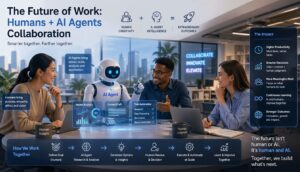
Agentic AI future of programming: We’re not just writing code anymore; we’re breeding it.
By 2026, the very notion of being a programmer will be nearly obsolete. As the world wondered if AI would replace programmers, something else was quietly happening in the background: agentic AI was transforming developers from simple keyboard operators to conductors.
If you’re still considering AI to be Copilot (i.e., a supercharged version of autocomplete), then you’re three years behind. Programming by 2026 will not be concerned with loops or logic gates but with intention, coordination, and faith.
This is the real picture of agentic AI within the context of the 2026 development environment.
What Exactly is “Agentic AI”?
Time to end the buzzword nonsense.
- Generative AI (2023): Generate a function based on your prompt.
- Copilots (2024): Write code suggestions within your IDE.
- Agentic AI (2026): An agential worker, granted a task (such as “migrate legacy payment gateway to microservices”), who will independently plan the architecture, generate PRs, run tests, set up cloud infrastructure, debug itself from its errors, and ask for human approval before making the final commit.
In 2026, an agent won’t be a tool anymore. It’ll be an employee with root privileges and a memory span of 10 million tokens.
The Death of “Coding” and the Rise of “Orchestration”
Here is a standard “program” example from 2026.
Traditional method (2024): The programmer writes a Python script that cleans the CSV file.
Modern approach (2026): The programmer uses natural language inputs to type:
“Agent: Launch a pipeline. Source: S3 bucket ‘incoming.’ In case of any null values in the ID column, send a GraphQL fallback request. In case of latency greater than 200ms, launch a parallel worker. Store the output in Snowflake. Budget: $5. Execute.”
The programmer didn’t write a single for loop. They specified the parameters and the goal. The Agentic framework solved the problem, allocated resources, and implemented the solution.
Your future profession: AI Orchestrator.
The 3 Pillars of Agentic Programming in 2026
For you to appreciate what makes it the future, you have to comprehend the inner workings.
1. Long-Term Planning & Memory
Whereas, in 2023, LLMs could only retain the context within a few thousand words, in 2026, Agents will have episodic memory. This means that Agents will be able to recollect why they had taken a certain action three days ago. This allows them to adjust their dynamic planning based on changing requirements.
2. Tool Use & Environmental Access
Agentic AI needs hands. By 2026, the Agent has been natively embedded into all major protocols: Git, AWS/GCP/Azure, Jira, Postgres, and even Slack. Not only codes; it kubectl applies code. It opens pull requests. It assigns tasks to their human coworkers. And it fails gracefully – rolling back the entire infrastructure in case the test suite fails by more than 2%.
3. Multi-Agent Swarms
There was never a single “super-agent.” Swarms are what is used today, in 2026.
- Architect Agent specifies the schema.
- Coder Agent creates the logic.
- QA Agent creates tests to break the Coder’s code.
- The Reviewer Agent searches for zero-day CVEs.
These agents debate, bargain, and vote. All that the human does is monitor the “Pull Request” page, where the swarm eventually agrees and he clicks “Approve.”
The Human Developer’s Role in 2026
But if it’s done by Agents, what is the human doing?
Ethics and Risk of Gatekeeping.
Agents can optimize beautifully; however, they cannot judge values. This part is yours. You decide whether or not we should make something and, most importantly, what is an acceptable rate of failures.
Debugging the Prompt Rather than Code.
If your Agent went haywire (“It deleted the production certificates”), you are not debugging the Python. Instead, you’re debugging your objective function. You are finding out that you have forgotten to include a constraint: “Don’t change IAM roles without double verification.” Your programming language is English (or Japanese or Spanish), but it should be legal-grade exact.
Edge Cases Are for Humans.
Agents take care of 80% right away. The rest—bizarre legacy integration, politically charged data migration, and the feature requiring empathy—is taken care of by humans.
The Ugly Truth: Technical Debt 2.0
However, there are some downsides. An agent will produce an unprecedented type of debt: Latent Complexity.
As agents code so efficiently, they are often overdoing things by refactoring code that doesn’t need to be. There is a strive towards achieving the ideal abstraction. As of 2026, we realize that the agents are too clever; for example, they use metaprogramming when a mere if-statement would be sufficient.
What’s more, “vibe coding” (allowing the agent to vibe and write code however it wants) leads to unmanageability. One cannot ask why an agent decided to implement the Bloom filter instead of the hash table. The consequence is perfect software that stops working randomly without any reason.
How to Prepare for the Agentic Shift (Action Plan)
If you are a programmer reading this in 2026, no need to freak out. The demand for software has gone up 10x. This is what you do:
Forget coding syntaxes. You never code a try/catch again in your life. Instead, focus on system dynamics.
Learn Prompt Engineering 2.0. Not “generate poetry,” but “limit action space.” How do you constrain an autonomous agent?
Get Forensic Ready. What happens when the swarm breaks? You need to be able to reconstruct the thinking process. That means knowing how to interpret agent logs (decisions over time).
Hone Your Soft Skills. The Agent can handle the technicalities. Now it’s time to deal with stakeholders with shifting priorities.
The Verdict: 2026 is the Age of Abundance
Agentic AI – Is This the Future of Programming? It’s not.
It’s now.
By 2026, startups will be created within two days. One person operates a hundred bots to keep the whole fintech back-end running. Coding speed won’t become the limit anymore – it will be the speed of understanding what was built by the swarm.
By 2026, the programmer doesn’t watch a green screen of a terminal anymore – they watch a swarm of bots doing their tasks, lights glowing – and they say to them quietly, “Good bot, deploy.”
Welcome to the Age of Orchestration.
Check Out – Smart AI toolkit