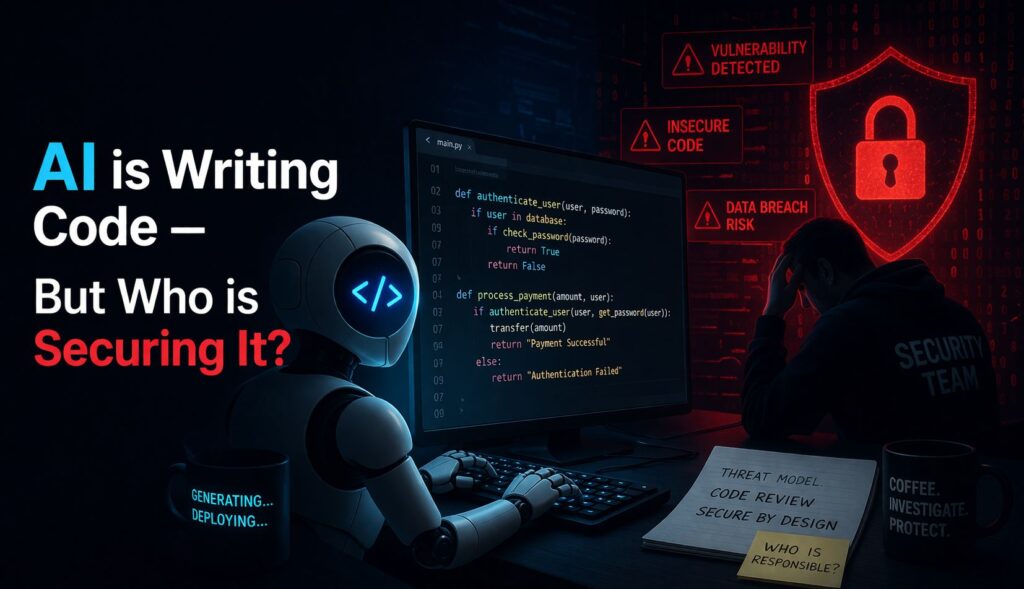
AI-generated code security: Not anymore! The question for 2026 isn’t whether “AI can author production code.”
The question is: “Who is going to review, validate, and secure the 40% – 60% of your code that the LLM produced in ten seconds?”
Developers are building at breakneck speed. Copilot, Cursor, Cody, and CodeWhisperer are not optional tools; they’re essential components. But in the quest to accelerate software development using AI, security will be the hidden liability—slowly growing and ignored until it becomes exploited.
One thing is certain: AI is great at writing code. But AI doesn’t reason about threats the way humans do.
The Silent Shift: From Human Bugs to AI-Generated Vulnerabilities
Software security, traditionally, was based on the idea that all code had been written by humans who were susceptible to fatigue, biases, and human errors. Today, a novice programmer can easily write thousands of lines of functional code by using artificial intelligence tools without knowing the impact of a function.
Here are some actual patterns discovered during 2025-2026 audits of AI-generated codebases:
- Insecure deserialization using Python Pickle and Java ObjectInputStream – since that was part of the learning experience for the AI.
- SQL injection through dynamically generated queries – since the coder forgot to request parameterization.
- Use of hardcoded secrets such as API keys and JWT secrets – as the AI was exposed to open repositories.
- Lack of access control for API endpoints – as the AI optimizes for performance over permissions.
- Outdated or vulnerable third-party libraries – as the AI relies on popular packages rather than secure ones.
🔍 Main takeaway from Snyk’s 2025 report on AI security issues:
Code produced by AI assistants had twice as many security vulnerabilities as human-produced code in similar scenarios.
Who is Actually Responsible? (No, not “the AI”)
The uncomfortable answer: Everyone and no one.
| Role | Current Reality |
|---|---|
| Developer | Assumes the AI is safe because it’s “intelligent.” Rarely audits generated code. |
| Security Team | Cannot keep up with 10x faster code output. Reviews are bottlenecked. |
| AI Vendor | Explicitly disclaims liability for security in terms of service. |
| CISO | Has no budget for “AI code review” because it’s still seen as a dev productivity line item. |
The problem lies in the organization. The AI creates the code. The developer relies on it. The security team never receives it. And the attack occurs.
This is the Accountability Gap – the most significant threat to today’s software supply chain.
The Three Layers of Securing AI-Generated Code
To actually get a tangible answer to who will be responsible for securing AI — here’s the actual architecture of security from DevSecOps experts in 2026.
Layer 1: Real-time guardrails (when code comes in)
Constraint for LLMs (no hardcoded secrets, no unsafe deserialization, and no eval()).
Scan by the client (via IDEs which detect any potential vulnerabilities suggested by an AI before the developer accepts it).
AI specific pattern detection (for instance, patches for imaginary vulnerabilities like CVE fixes).
📌 So who will manage this? – Platform engineering and dev experience team.
Layer 2: Post-Generation Scanning of Code by Automation System (PR)
SAST – configured to detect code generated by AI in specific patterns (not static legacy rules).
AI-generated blocks to be scanned under secrecy.
Vulnerabilities in dependencies detected, including whether the dependency is suggested by AI.
📌 Who operates? – Security automation.
Layer 3: Humans-in-the-Loop for Important Code Paths
For any code that affects authentication, payments, personal info, or infrastructural elements – human security analysis mandatory.
AI to analyze (point out risks), but final approval required by human.
📌 Who operates? – Application security engineers & senior developers.
The Hard Truth: Most Organizations Are Not Ready
A 2026 survey by Palo Alto Networks/Unit 42 of 500 CISOs found:
- 78% use AI-produced code in production environments.
- 19% have a policy to review code written by AI.
- 12% have automated guardrails before AI recommendations make it into code.
We are, in effect, running a global experiment in which AI enables vulnerabilities to be inserted more quickly than they can be detected or fixed.
What Actually Works Right Now
From actual implementation in the wild (FinTech, SaaS, HealthTech):
Code reviews must detect contributions from AI — git commit history must have “Generated by Copilot/Cursor/Claude.”
Security guardians within development teams — one developer per team who is tasked with reviewing AI code in pull requests.
Scan for bias due to overgeneration of specific categories of vulnerabilities (injection, weak encryption, insecurity-by-default).
No AI use for secure components — organizations prohibit AI use in cryptography, identity management, audit logging, or secret rotation logic.
Detect at runtime — since even an insecure code generated by AI may be detected through RASP/eBPF runtime instrumentation.
The Future: AI vs AI Security
The only long-term solution is asymmetric defense.
- AI attacks will create polymorphic exploits targeting AI-created software (this already happens in red team experiments).
- AI defenses will have to perform reverse engineering on AI software to uncover logic flaws.
- AI log monitoring will be required for compliance purposes (SOC2/ISO 27001 will ask: “How do you protect your AI code?”).
But right now, the human security engineer remains the ultimate decision-maker – exhausted, overstressed, and outnumbered 100:1 by AI agents.
Conclusion: The Buck Stops With Engineering Leadership
The AI didn’t merge the pull request. The developer did.
The developer didn’t skip the security review — their manager did when they prioritized velocity over verification.
Who secures AI-written code?
Not the AI vendor. Not the model. Not the tool.
Engineering leadership — by mandating guardrails, tooling, reviews, and accountability.
Until we treat AI-generated code as high-risk third-party code written by an intern who never sleeps, we will keep shipping vulnerabilities faster than we can patch them.
Check Out – Smart AI toolkit