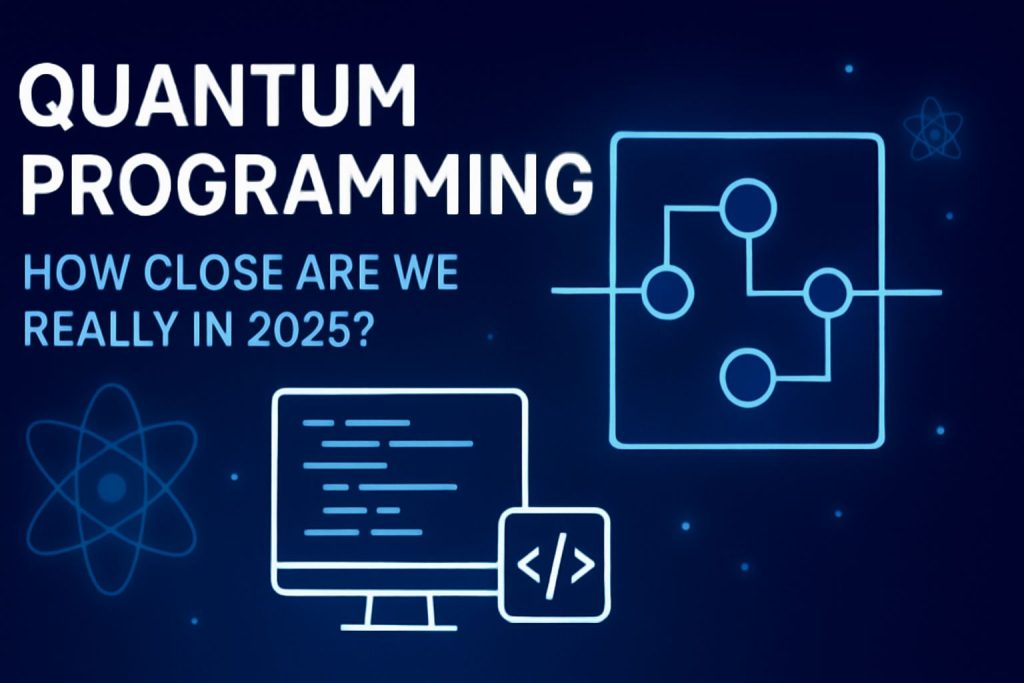
Quantum programming is no longer a concept restricted to labs and research papers. In 2025, it is gradually transitioning into the real world, attracting global attention from researchers, developers, and large tech companies. But an important question arises — are we truly close to a quantum-powered future, or is it still far away?
This article explores the complete picture of quantum programming in 2025, including:
- What quantum programming is
- Popular quantum programming languages (Q#, Qiskit, Cirq)
- Real-world applications
- Key challenges holding it back
- Why big tech companies are investing
- The future outlook beyond 2025
- Frequently asked questions (FAQ)
What is Quantum Programming?
At its core, quantum programming is the practice of writing software for quantum computers, which differ significantly from traditional systems. Unlike classical computers that rely on bits (0s and 1s), quantum computers use qubits.
Qubits can exist in multiple states simultaneously, a property known as superposition, and can influence each other through entanglement. Together, these properties allow quantum computers to solve highly complex problems exponentially faster than classical machines.
👉 Example: A traditional computer may take years to simulate molecular interactions for drug discovery. A quantum computer, through quantum algorithms, could reduce this time to hours or even minutes.
Thus, quantum programming involves creating algorithms and software that can utilize these properties to solve real-world problems in healthcare, finance, AI, and more.
Why Quantum Programming Matters in 2025
In 2025, industries are facing challenges that classical computing alone cannot solve efficiently. Big data, climate modeling, AI training, and cybersecurity require enormous processing power.
Quantum programming provides:
- Speed: Faster calculations for highly complex models.
- Efficiency: Ability to solve optimization problems.
- Innovation: Opens doors for breakthroughs in medicine, energy, and space research.
Governments and tech giants alike recognize that whoever controls quantum technology could lead the next technological revolution.
Top Quantum Programming Languages in 2025
Let’s break down the three most prominent languages used today.
1. Q# (by Microsoft)
- Integrated with Azure Quantum.
- Offers a structured environment with quantum libraries.
- Good for developers who want a robust ecosystem.
- Works seamlessly with Visual Studio and .NET, making it developer-friendly.
2. Qiskit (by IBM)
- Open-source and Python-based.
- Provides direct access to IBM’s cloud-based quantum computers.
- Most widely used framework by researchers and developers.
- Strong community and learning resources, making it beginner-friendly.
3. Cirq (by Google)
- Focused on NISQ (Noisy Intermediate-Scale Quantum) devices.
- Offers flexibility for researchers building custom circuits.
- Strong integration with TensorFlow Quantum for AI applications.
Other honorable mentions: Quipper, ProjectQ, and Ocean SDK (from D-Wave).
Real-World Applications of Quantum Programming
Quantum programming is still in its early stages, but industries are already experimenting with practical use cases.
1. Drug Discovery and Healthcare
Pharmaceutical companies use quantum algorithms to simulate molecular structures, speeding up drug discovery and personalized medicine.
2. Cryptography and Cybersecurity
Quantum computers may break existing encryption methods. As a result, researchers are working on post-quantum cryptography, ensuring secure communication in the future.
3. Finance and Risk Management
Banks and financial institutions explore quantum computing for portfolio optimization, fraud detection, and real-time risk analysis.
4. Artificial Intelligence and Machine Learning
Quantum machine learning (QML) could revolutionize model training, allowing faster, more accurate AI systems.
5. Logistics and Supply Chain Optimization
From airlines planning fuel-efficient routes to e-commerce optimizing deliveries, quantum programming enhances resource allocation at scale.
6. Climate and Energy Research
Quantum simulations help model climate change scenarios and explore new materials for renewable energy.
Challenges of Quantum Programming in 2025
Despite exciting progress, several hurdles remain:
- Hardware Limitations
- Qubits are fragile and prone to errors and decoherence.
- Maintaining stability requires extremely low temperatures.
- Error Correction
- Quantum error correction is resource-intensive, making large-scale systems difficult.
- Talent Shortage
- Skilled quantum programmers are rare, creating a huge demand-supply gap.
- Cost Factor
- Developing and maintaining quantum systems is expensive, limiting access for smaller organizations.
- Scalability Issues
- Most existing systems are limited to a few hundred qubits, far from the millions needed for general use.
Why Big Tech is Investing in Quantum Programming
Major companies and governments see quantum computing as a strategic priority.
- IBM: Aims to scale beyond 1,000+ qubits and offer cloud quantum services.
- Google: Focused on quantum supremacy and NISQ-era experiments.
- Microsoft: Building a robust developer ecosystem with Azure Quantum.
- Amazon (Braket): Offering cloud-based access to multiple quantum machines.
- Startups (Rigetti, IonQ, Xanadu): Innovating quickly with specialized hardware.
💡 The race is about first-mover advantage. Whoever masters quantum programming first could lead in healthcare, finance, defense, and AI.
The Future of Quantum Programming Beyond 2025
Looking ahead, here’s what we can expect:
- Hybrid Systems → Classical + quantum computers working together.
- More Cloud Access → Developers worldwide experimenting without owning hardware.
- Post-Quantum Cryptography → New encryption standards for the quantum era.
- Industry-Specific Solutions → Tailored applications for healthcare, aerospace, and energy.
- Open-Source Collaboration → Growth of communities like Qiskit, Cirq, and Quantum ML frameworks.
Though mainstream adoption may take another decade, the groundwork being laid in 2025 makes the future much closer than before.
Frequently Asked Questions
Quantum programming is the process of writing software for quantum computers that use qubits instead of classical bits. It enables faster solutions for complex problems.
The top languages are Q# (Microsoft), Qiskit (IBM), and Cirq (Google).
Applications include drug discovery, finance, AI, cybersecurity, logistics, and climate modeling.
Challenges include unstable qubits, error correction, high costs, scalability issues, and shortage of skilled developers.
Because quantum breakthroughs can transform industries, offering strategic advantage in AI, finance, healthcare, and defense.