For decades, software development has been an art of problem-solving—writing algorithms, debugging logic, and carefully optimizing performance. Over the years, new programming paradigms have emerged to make developers more productive: from procedural programming to object-oriented programming, from frameworks to low-code platforms, and most recently, AI-assisted coding tools like GitHub Copilot and ChatGPT.
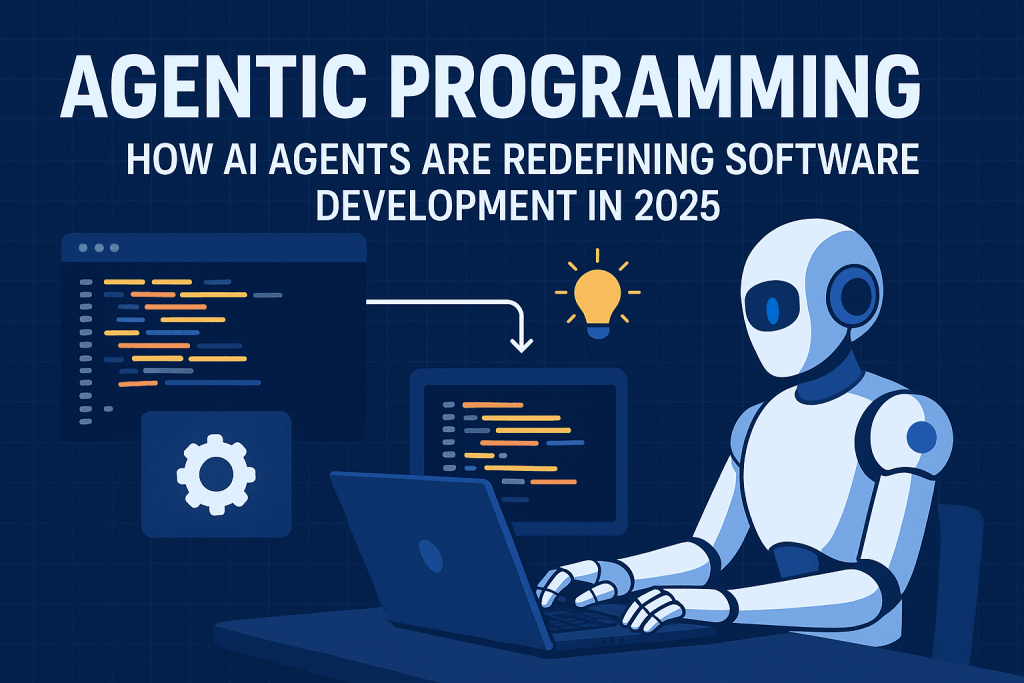
But in 2025, we’re witnessing a paradigm shift even bigger than Copilot—a shift toward Agentic Programming, where AI agents not only assist developers but autonomously plan, code, debug, and ship software with minimal human intervention.
This is more than just speeding up coding—it’s a reimagination of what it means to be a programmer.
What is Agentic Programming?
Agentic Programming is a new approach where developers give high-level goals (e.g., “Build a REST API for a blog that stores posts in MySQL”), and AI agents independently figure out how to achieve them.
Unlike traditional programming, where you manually write every line, or AI-assisted programming, where tools suggest code snippets, Agentic Programming treats AI as an autonomous developer.
Think of it as hiring a virtual junior developer who:
- Reads your instructions,
- Plans the project,
- Writes the code,
- Runs the debugger,
- Tests functionality, and
- Iterates until it works.
It’s not “AI helping you code”—it’s “AI coding for you.”
How Agentic Programming Works
The workflow of agentic programming can be broken into five stages:
- Goal Interpretation
- You describe a requirement in natural language (e.g., “create a login system with email and OTP authentication”).
- The AI agent breaks it down into actionable tasks.
- Planning
- The agent outlines architecture: which framework to use, what database schema to design, and what APIs to expose.
- Execution
- It writes the code, integrates libraries, configures environment files, and sets up the build system.
- Testing & Debugging
- Runs unit tests, integration tests, and automatically fixes errors when code fails.
- Deployment & Iteration
- Pushes code to GitHub, deploys to cloud platforms, and continues monitoring for bugs.
Effectively, the AI acts as a self-managing developer, with you guiding it through goals rather than line-by-line coding.
Benefits of Agentic Programming
- 🚀 Faster Development Cycles
- What once took weeks (MVPs, prototypes) can now be built in hours.
- 🛠️ Continuous Debugging
- AI agents can watch for runtime errors, fix them automatically, and push updates without human intervention.
- 🤝 Bridging the Skills Gap
- Non-technical founders and business leaders can build working software by just describing what they want.
- 💡 Higher Productivity for Developers
- Developers act as project architects and quality controllers instead of spending time on repetitive coding.
- 🌍 Global Accessibility
- Makes coding more inclusive by lowering the barrier for people with little programming experience.
Challenges and Risks
Despite its promise, agentic programming brings serious challenges:
- ❌ Over-Reliance on AI
Developers risk losing core programming skills if they depend too heavily on agents. - ⚠️ Security Risks
An AI agent could unknowingly import vulnerable dependencies, misconfigure APIs, or introduce security flaws. - 🔍 Quality Control
AI can generate code that works but is inefficient or unmaintainable at scale. - ⚖️ Accountability & Ethics
Who is responsible when an AI-generated system fails—developers, companies, or the AI provider? - 💼 Job Disruption
Entry-level coding roles may shrink, pushing developers toward architecture, oversight, and AI governance.
Real-World Use Cases
Agentic programming isn’t just theoretical—it’s already finding applications:
- MVP Development for Startups
- Entrepreneurs can describe their product idea, and an AI agent delivers a working prototype in days.
- DevOps Automation
- Agents set up CI/CD pipelines, manage deployments, and optimize server configurations.
- Bug-Fixing Bots
- Continuous monitoring agents detect, reproduce, and patch bugs—sometimes faster than human developers.
- Maintaining Legacy Systems
- Instead of humans reading outdated COBOL or FORTRAN code, agents interpret, refactor, and modernize it.
Agentic Programming vs. AI Coding Assistants
| Feature | AI Coding Assistants (e.g., GitHub Copilot) | Agentic Programming |
|---|---|---|
| Role | Suggests snippets | Builds complete systems |
| Control | Developer-driven | Goal-driven (AI autonomy) |
| Output | Partial code | Full workflows |
| Dependency | Helps productivity | Potentially replaces coding tasks |
| Risk | Low (human oversight required) | High (quality, ethics, control) |
Future of Agentic Programming
As we look ahead, agentic programming could reshape software engineering in profound ways:
- Integration with New Languages
- Languages like Mojo (Python-like but blazing fast) and Rust (safe & efficient) are natural fits for AI agents.
- Edge AI & IoT
- Imagine AI agents writing optimized firmware for IoT devices or autonomous vehicles.
- Quantum Programming
- Hybrid AI agents could manage classical + quantum workloads, making quantum computing accessible.
- Developer Roles Will Change
- Future developers won’t be writing “for loops.”
- They’ll be orchestrators, strategists, and ethical overseers guiding armies of AI agents.
Conclusion
Agentic programming marks the next frontier of software development. It’s not just about faster code—it’s about shifting the role of programmers from coders to directors of intelligent agents.
Yes, there are risks: over-reliance, security issues, and ethical concerns. But the potential is revolutionary—empowering businesses, accelerating innovation, and opening the door to a world where anyone can build software.
2025 is the year coding stopped being about lines of code—and started being about lines of intent.
✅ Key Takeaway: Agentic programming is not here to replace developers—it’s here to transform them into creators of systems, not just code. The sooner we embrace this, the more future-proof our skills will be.