The past three years have seen the entire discussion of Artificial Intelligence framed around one overriding theme that causes widespread fear and worry: Will AI replace me at work?
Journalists warn of millions being replaced by automation, artists protest against the use of AI-based generators, and programmers fear for their jobs while watching AI produce more sophisticated codes. Yet when you tune out the noise and talk to the technologists designing the future or the economists analyzing efficiency, you realize that a very different conversation is taking place.
The revolution taking place is not about replacement, but rather about partnership.
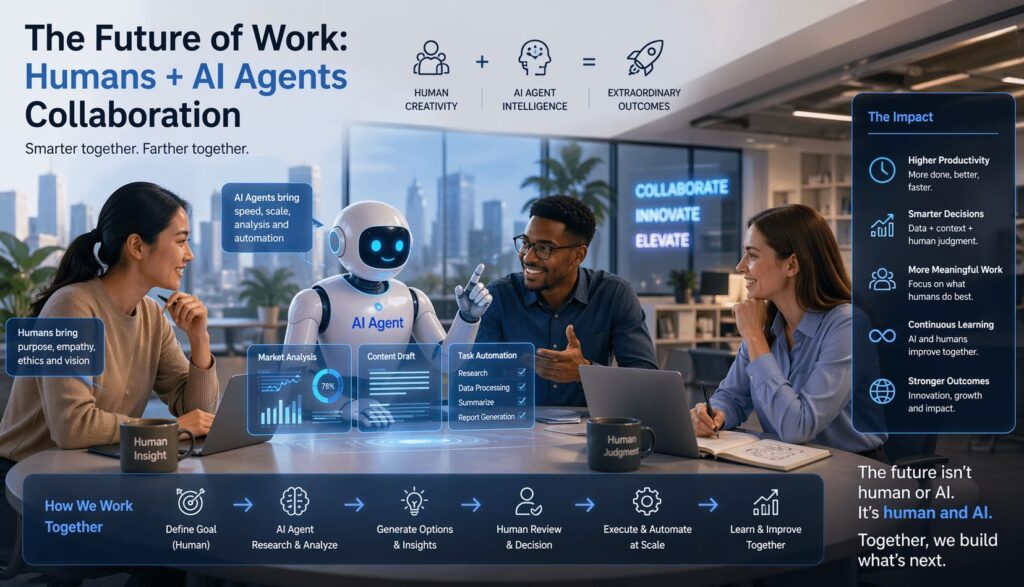
We are living in the age of Human-AI Agents. This means that the most useful worker will no longer be the person who writes the code or the copy the fastest; instead, he or she will be the one who is able to coordinate a team of AI agents to do the job.
The “Co-pilot” Paradigm
If you want to know the future, just look around. The Co-pilot era came quickly in 2024 and 2025. Microsoft, Google, and 12 startups have built AI into the very way we work. However, the co-pilot is only the start. An agent is different from a co-pilot.
A co-pilot steers the ship for you. An agent steers the ship as you navigate.
Think about a world where your intelligent machine doesn’t just offer suggestions for how to respond to your emails; it also reviews your calendar, takes into account your preferences when traveling, coordinates schedules with the AI system that represents the client, makes your flight reservations, and revises your expense reports.
That’s what it means to move from Tools to Teammates.
The Three Layers of Hybrid Collaboration
What does this look like in practice in the year 2030 on a Tuesday morning? Let’s dissect the process into three separate tiers.
1. The Amplifier (Data to Insight)
Human beings are gifted at intuiting and making sense of things, yet we can never remember a number or statistic. Our minds are prone to fatigue, while artificial intelligence possesses perfect memory and no intuition.
The Collaboration: The AI agent analyzes petabytes of information (statistics on sales, logistics, consumer sentiment) within mere seconds. It identifies the problem—a 15% reduction in retention rate in Asia—and highlights three reasons why this occurred.
The Human’s Job: You review the information. You remember a cultural idiosyncrasy the computer did not catch or a conversation you had last week with a partner that is not logged in any report. You identify the correct solution and instruct the computer to implement it.
2. Executor (From Idea to Execution)
The main constraint in current business is not an idea but its execution. There are numerous hours spent by people in administrative work, preparing presentations, coding, and scheduling tasks.
Collaboration: In your scenario, you give instructions to the agent. “Agent, create a marketing budget for the third quarter based on three KPIs from this template but taking into account inflation.”
Human Role: The agent sends back the first draft within 15 seconds. Examine the model. You see that the algorithm optimized spending, while the CEO prioritizes brand visibility. You change the requirements. The model is recalculated.
The Critic (Emotion to Ethics)
As AI becomes more intelligent, it does not become more wise. It lacks shame, fear, or even hope. AI cannot determine whether an action is “just.”
The Collaboration: You develop a plan for layoffs using AI analytics that reveal redundant departments. Your AI agent will alert you about your plan not out of care but because you instructed it to do so for legal and reputational reasons.
The Human Contribution: You, the human being, provide the empathy. You decide how to implement the tough decision with respect. AI can inform you who will be impacted, but only you can choose how to handle it.
The Rise of the “Centaur” Worker
Greek mythology describes the Centaur as a composite being that had the speed of a beast along with the brains of a human. In the context of data science, this definition can be reapplied to the age of AI. The Centaur is a type of employee who shares work with AI to harness their strengths.
Who is a Centaur?
The Marketer: Deploys AI to produce 50 iterations of the advertisement (efficiency), but decides which iteration captures the essence of the brand’s story (taste).
The Lawyer: Employs AI to go through 10,000 legal contracts looking for one clause (precision), but engages in a discourse about that clause during mediation (rhetoric).
The Doctor: Employs AI to read the radiology test results (pattern recognition), but maintains eye contact with the patient when delivering the diagnosis (compassion).
The Centaur doesn’t shy away from the machine; he rides the beast.
The Skills That Matter Now (Resilience vs. Repetition)
If we outsource the tasks of repetition to AI agents, then what remains for us?
1. Prompt Engineering as the Key Literacy
Learning Python programming is not necessary for all, but learning to communicate with a machine through prompts will be necessary by 2030, much like the use of Google Search engines is today.
2. Verification over Creation
What changes is that instead of producing the product, we’ll be responsible for curating the product. We’ll become the editors, fact-checkers, and QA experts. The ability to detect a “hallucination,” wherein an AI confidently spouts bullshit, has become a rare skill.
3. Emotional & Social Intelligence
AI can’t hold hands during a crisis. can’t boost the morale of a disappointed group after a failed product release. AI can’t sense the mood in the room during difficult negotiations. As AI becomes more sophisticated, Soft Skills will be your only valuable, non-automatable asset.
The Organizational Shift: Managing Hybrid Teams
There lies an immense challenge to leaders. They can neither lead a human being nor an AI in the same manner.
Performance Evaluation: How would you rate an AI agent? You wouldn’t. You will rate the person behind this agent. Has the person utilized the agent for saving 20 hours per week? Or have they simply followed up on their agent’s inaccurate suggestion?
Transparency: “Black Box” AI is not going to work here. The future of work demands transparency, and humans need to understand how and why an agent recommends a particular price point or hire.
Four-day Work Weeks: This is the hidden potentiality. Should the AI agents enhance our productivity by 30-40% without overworking us, there is no need for “letting go” of 30% of our employees. What we are supposed to do is cut back our working hours by 30%.
Conclusion: The Floor is Rising
But let’s be absolutely frank. Some jobs will simply disappear. Jobs that involve just simple data entry, translation, or legal writing will soon join the ranks of elevator operators.
And here’s the good news: The bar of productivity is being raised. Tasks that required a senior executive before are being done by the junior associate because of their AI agent. This makes skills more democratic.
The future of work isn’t a struggle for survival against the machines. It’s a teaming partnership where AI agents supply the power while humans supply the passion.
Instead of asking whether AI will take your job away, start thinking about how well you can partner up. Because the thing is, your robot helper needs no workspace, no office chair, and definitely no coffee breaks. However, your robot does need your expertise.
Are you prepared to become a Centaur?
Check Out – Smart AI toolkit