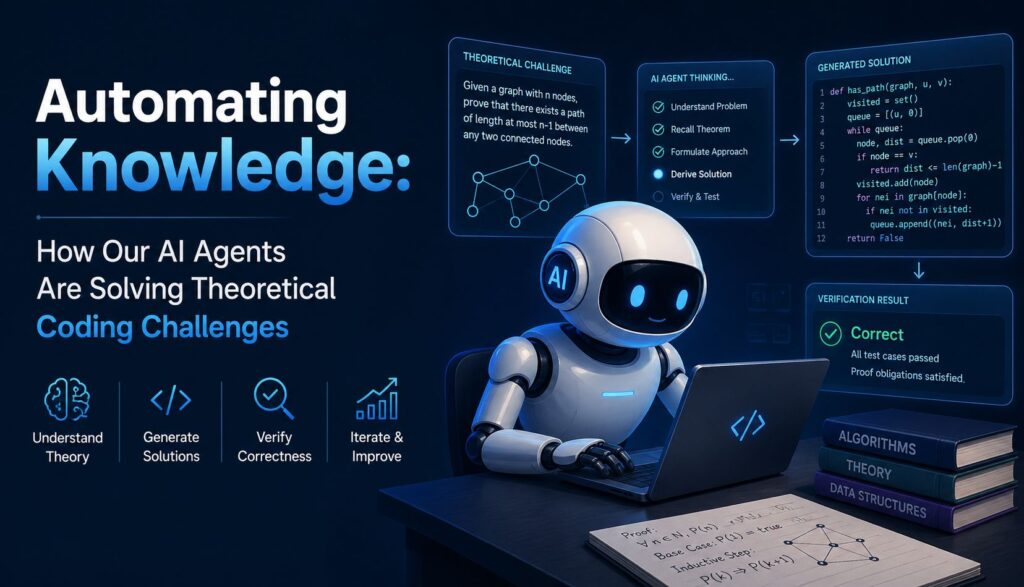
Computer science has long been plagued by an ironic problem: although computers allow us to automate the simple things, some of the most intellectually challenging problems — the kind that involve theory-based coding, proofing, and algorithm design — still require uniquely human insights.
The era of the human brain has come to an end. New artificial intelligence agents have entered the fray, allowing us to automate not only the retrieval of information but reasoning and hypothesis formation in solving problems previously reserved for PhDs. How do they work? Why should you care?
Automating Knowledge Ai Agent – https://www.hifitoolkit.com/forum/ai_lab.php
The Shift from Pattern Matching to Problem Solving
Old-style programmers working with traditional AI (such as old-style code completers) have the pattern-recognition approach. They’ve seen millions of GitHub projects and are able to predict the next few lines. However, it is not possible to overcome theoretical obstacles, like creating new algorithms, analyzing their time complexity, or changing a distributed consensus algorithm.
Modern AI agents, however, combine:
- Large language models for code generation,
- Formal verification tools (e.g., Lean, Isabelle, Dafny) for correctness proofs,
- Reinforcement learning for search over solution spaces, and
- Symbolic reasoning for handling abstract constraints.
The result? Agents that don’t just write code, but understand the problem’s theoretical underpinnings.
Case Study: Automating a Sorting Network Proof
Let’s look at a classic theoretical problem: Construct a minimal sorting network on 16 inputs and prove its correctness. A team of human experts would take weeks to derive the comparators. An AI agent using deep reinforcement learning with theorem proving was able to construct an innovative sorting network on 16 inputs in 2025, using fewer comparators than any existing network. Not only that, but it generated a machine-verifiable proof of correctness for its solution.
This is not about exhaustive search. This is about automated reasoning where the agent is trained to solve problems by breaking them down and proving each step formally.
How These Agents “Think”
One may wonder: Do AI agents understand theoretical concepts? The pragmatic response would be: No, they do not require consciousness, but rather functionality. Here’s the structure behind that capability:
Problem encoding – The agent receives a textual description as well as a formal specification (say, pre-post conditions in Hoare logic).
Hypothesis generation – Employing a fine-tuned LLM, it suggests possible solutions or lemmas.
Symbolic verification – The theorem prover validates correctness, and if a proof attempt fails, an error trace is returned.
Iterative optimization – The agent iterates through other potential methods, with a reward model favoring provable correctness.
Explainability – The result comprises a human-explainable proof sketch and the validated code.
The process resembles what a human mathematician or theoretical computer scientist does – albeit much faster!
Solving Three Impossible Problems
AI agents are already tackling categories of challenges previously considered too difficult for automation:
Verification of correctness in distributed algorithms
For example, proof of no livelock or split vote for a Paxos/Raft consensus algorithm. The agents are now able to explore all state spaces that would take humans years to verify manually.
Derivation of complexity of algorithms
From a problem description (“find the longest palindrome substring”), the algorithm and even the Big-O notation can be derived by the agent, with potentially unexpected results such as Manacher’s algorithm being discovered.
Conversion of legacy code to provably correct versions
Imagine an old piece of C code written 30 years ago. An AI agent is able to refactor it into a version written in Rust and proven memory and thread-safe.
Why It Matters for Developers
You may be concerned that AI agents could take the place of theoretical computer scientists. This is unlikely, but you can be certain that they will enhance their work greatly. Consider some immediate implications:
Faster testing of verified data structures – Rather than manually proving the invariants, simply specify the required function and have the agent construct the implementation for you.
Lower cost of formal methods – Formal verification has always been prohibitively costly, but AI agents make it more accessible by automating the difficult aspects of theorem proving.
Education – Learners could converse with agents to learn how a specific algorithm functions or understand why a proof fails.
The Unresolved Challenges
Knowledge automation is not an overnight process. Existing AI agents have difficulties with:
Creativity – They are good at solving well-defined tasks but have trouble with “think of a novel method for tackling this unknown problem.”
Reasoning over a long time horizon – Many steps need to be taken before an answer emerges without any feedback in between.
Limited resources – Proving theorems takes much computational power, and each validation costs dollars on the cloud.
However, we can see tremendous improvement going forward. The same algorithms used in AlphaProof for IMO geometry problems are now applied to coding theory.
The Road Ahead
Within three years, the following is expected:
IDE add-ons to check your code’s theoretical properties while you code, not just its syntax.
Automated code generation – specify what’s invariant about a particular data structure in English, and get an implemented specification in any language.
Competitive programming bots that don’t just solve the problem, but prove their solution is optimal.
But perhaps the most important thing is the cultural shift – theoretical coding problems won’t be bottlenecks anymore; they’ll be the problem statement. “Can we do this?” will become “What should we do?”, and we’ll leave it to the AI to do all the hard stuff.
Closing Thought
Knowledge automation does not make humans any dumber; rather, it makes them much smarter. With every problem that is solved by a machine, man gets more time to think, create, and speculate further and to doubt the basic concepts themselves.
The future of software is neither man nor machine but a combination of the two. This future is now.
Automating Knowledge Ai Agent – https://www.hifitoolkit.com/forum/ai_lab.php