AI agents vs traditional apps: Think about waking up the next day. Pick up your phone. There are no buttons to click. There are no endless stacks of banking, fitness, grocery, or email apps. Rather, all you do is give a voice or a text command: “Create my weekly schedule, analyze my investments, and book my dinner for seven.” Bam, it’s done. Without logging in. Without waiting for pages to load. And without training.
Because what I’ve just described is not the future anymore. It’s an inevitable future of artificial intelligence assistants—and the final blow to the conventional app era.
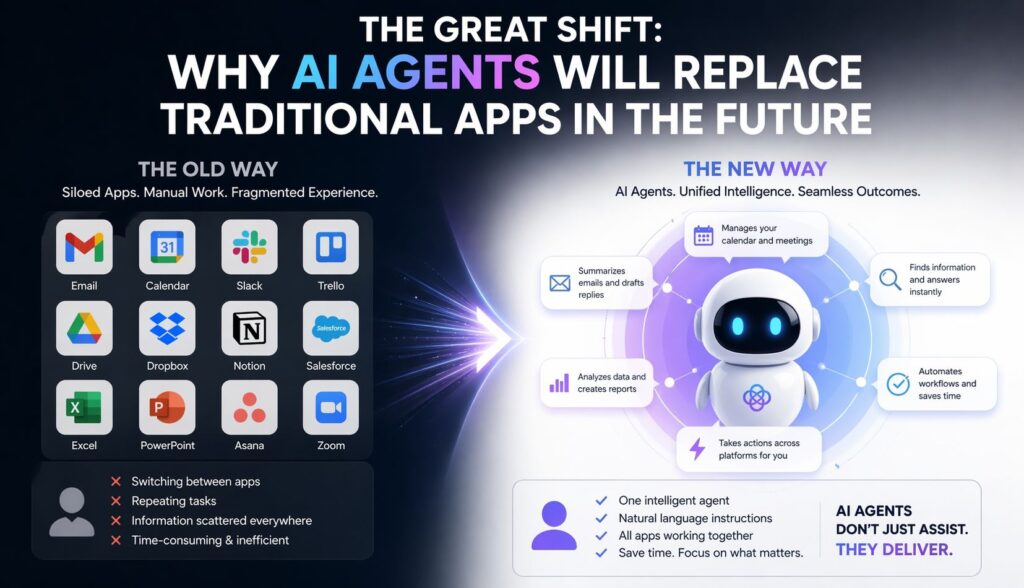
The “App Economy” has dominated for 15 years. We have become accustomed to thinking that for every issue there should be a dedicated app. Need transportation? Download Uber. Need air travel? Download Kayak. Need to edit a photo? Download Lightroom. However, the approach is flawed because it makes us play the role of an operating system by transferring information manually between silos. In the future, you will no longer serve the app but vice versa; the app (more precisely, the agent) will serve you.
Here are the reasons behind why switching from apps to AI agents is a paradigm shift and not simply a replacement.
The Hidden Tax of the App Era
For us to see how AI-powered agents are going to triumph, let’s start by understanding the unseen tax on traditional applications: cognitive load.
Right now, you have a goal to accomplish (such as “I want to organize a birthday celebration”). In order to achieve this goal, you have to split it into many smaller goals such as opening up a notes application to create a checklist, switching to a calendar application to check for the availability of date, using a messaging application to invite friends, using a food delivery application to book the cake, and so forth.
Each transition involves context switching. Research indicates that it takes more than 20 minutes to regain focus after switching among complex digital applications. Conventional applications are just passive containers. They store your data, but they cannot do anything with the information stored until you turn the knobs.
The whole paradigm changes with the advent of AI agents. The concept of AI agent refers to something very different from conventional apps. AI agent is not a container but rather an active participant. It has its own agency.
What Exactly is an AI Agent?
Let’s start by defining some terms. Traditional applications (such as Excel and Spotify) are deterministic programs. You press Button A, and you’ll get Result B. They don’t learn your behavioral patterns, nor do they predict what you need.
The AI Agent is essentially a Large Language Model (LLM) with the addition of permissions and memory. Instead of merely processing input information, it interacts with it. Based on the studies carried out by visionary technologists such as OpenAI’s GPT models and Rabbit’s Large Action Model (LAM), an AI Agent can:
- Intent recognition: “Book a flight” vs. “Book a flight if price is less than $400”
- Strategy: Decompose “Book a flight” task to search, compare prices, pay, and add to calendar.
- Action: Click on buttons or make an actual call to APIs of airlines.
- Experience gain: Know your preferences; you like window seats and hate connecting flights for more than 2 hours.
In short, the traditional app is a hammer; the AI Agent is a robot that knows how to build a house.
From “There’s an App for That” to “There’s an Agent for That”
1. The Death of the User Interface (As We Know It)
The first change that will happen is that the GUI will become a thing of the past. We have been using WYSIWYG (What You See Is What You Get). The future will bring us WYGIFY (What You Get Is What You Want).
If today you wish to make a detailed spreadsheet regarding the performance of your sales figures, you will have to go through Excel’s menus, formulas, and macros. With the AI Agent, you just need to say, “Analyze my sales data. Identify the three worst-selling products and make a budget for a recovery plan.”
Impact: Access will increase exponentially. Even your grandmother, who would never be able to use any CRM software, will be able to conduct her business without difficulty.
2. Integration Without the Headache
The “Super App” approach (similar to WeChat in China) attempted to address the issue of fragmentation by consolidating all features into a single application. However, Super Apps are monolithic. AI Agents represent a better alternative to this: Interoperability.
Currently, integrating Strava metrics into your meal prep app needs a third-party service such as Zapier or IFTTT. This method is fragile. An AI Agent serves as a unified orchestrator. The Agent can log into your banking account, verify your Venmo, read emails in Gmail, and reconcile with your Notion task list at the same time.
When regular applications become obsolete, the “API” replaces the interface. Firms will not be competing on whose icon looks prettier; they will be competing on how well their agents communicate with each other.
3. Proactive vs. Reactive
Standard apps are passive. They remain dormant until you shout instructions to them. AI Agents are active.
- Standard App: You visit Weather.com to check for rain.
- AI Agent: The agent recognizes that you have a garden; it detects the forecast for frost today and sends you a message: “I’ve arranged for the delivery of frost covers at 4 pm and postponed your early-morning meeting to allow for covering the tomatoes.”
This transition from “search” to “synthesis” is radical. Your app changes its status from utility to collaborator. As the software anticipates your needs without you needing to express them, the notion of opening an app becomes meaningless.
The Technical Inevitability
The skeptics would argue that we’ve seen all of this happen before – think about chatbots. But this time, the combination of three emerging technologies makes this scenario far more likely than ever:
- Foundation Models: GPT-4 and Gemini reason beyond just code; they reason and are able to deal with ambiguity.
- Action APIs: Businesses such as Uber, DoorDash, and Salesforce are already developing “action models,” which enable AI to transact.
- Memory: With long-term memory vectors, agents can recall contextual information from a week ago.
On top of that, the emergence of Rabbit OS, as well as the Humane AI Pin, demonstrated the desire for action despite some initial glitches. We want to act, not administer, while the hardware catches up.
The Economic Case: Cheaper Than Freemium
Why will developers switch from building traditional apps? Profit.
The development of one app for iOS and Android can cost up to a few hundred thousand dollars. Then you struggle with App Store optimization, take into account 30% platform fees, and hope for the best when it comes to downloads.
Creating an AI Agent is less expensive. You have to develop an API and a prompt for your language model. You distribute it through voice or text queries. And if your agent specializes in booking flights, all other agents (general assistants) will utilize yours.
We are shifting from a software-as-a-service (SaaS) economy to a task economy. No one would pay $15 per month for Photoshop. They will pay $0.10 for “Background removal of this photo” or subscribe to an “Art Director Agent” that uses Photoshop internally.
The Resistance: What About Privacy and Control?
Indeed, this change is very scary. To give an AI agent access to your bank account, email, and calendar is quite scary.
The Rebuttal: Trusted Execution Environment and on-device AI like the one from Apple Neural Engine solves the problem. Your AI will definitely be running in the so-called “sandbox,” where you will give it very specific permissions, for example, “Agent, you may view my calendar, but you cannot post on my Twitter.”
Moreover, we already have applications which can access and do stuff with our information. What is different now is that instead of having apps that store our information, we will be using agents who use our information. The danger to privacy is still there, but the regulation will make sure that people understand what happens, and we will learn to trust our agents more than applications run by companies.
What Will Survive?
Will All Apps Be Killed? Not really. Some types of applications will hold their ground:
- Fidelity Creation Tools: An architect, a musician, a video editor, will need a canvas to touch. But eventually, even those will go “headless”—with agents doing the mundane tasks like rendering, exporting, versioning.
- Video games: It’s in the name, the point of a game is the interface. Press the jump button. They are safe—for now.
- Medical Devices: We may not like the idea of an agent suggesting changing the dose of an insulin pump. There, deterministic safety matters.
But for 80% of your mobile application portfolio—banking, travel, shopping, productivity, news—the end is near.
The Timeline: When Will This Happen?
This is where we are today – in the “Copilot” age (2023-2025). AI co-exists with the application (for example, Copilot by Microsoft in Word).
In the “Agent” age (2026-2028), apps will go headless. You may have Uber installed, but you will never launch it. Instead, your agent will connect to Uber’s agent.
By 2030, the idea of an “App Store” will seem as old-fashioned as the concept of “Video Store.” All interactions will revolve around conversations and swarms of specialized agents running behind the scenes. Only results appear on your screen.
Conclusion: You Are the Platform(AI agents vs traditional apps)
A conventional app was a prerequisite in the history of computer development, bridging the era of command lines with the advent of touchscreen. However, the app model presupposes that humans have unlimited time and patience in order to navigate through any interface.
By contrast, AI agents bring about equilibrium. In this context, humans are back in the center of the universe, rather than software. The future will never ask the question, “Is there an app for that?” Instead, we would simply say, “Can you do that?” The answer would almost always be yes.
It’s not the future where phones are populated by apps. The future lies in conversations.
Check Out – Smart AI toolkit