Artificial Intelligence (AI) is no longer a futuristic dream; it’s a present-day reality rapidly transforming industries, societies, and even our daily lives. From self-driving cars and intelligent personal assistants to medical diagnostics and financial forecasting, AI models are at the heart of this revolution. But what powers these sophisticated creations? What are the fundamental programming languages that data scientists and AI engineers wield to bring these intelligent systems to life?
If you’re looking to dive into the exciting world of AI model development, one of the first and most crucial decisions you’ll face is choosing the right programming language. This isn’t a one-size-fits-all answer, as each language brings its own strengths, ecosystems, and communities to the table. In this comprehensive guide, we’ll explore the top contenders, weighing their pros and cons to help you make an informed decision on which language best suits your AI aspirations.
The Undisputed King: Python
When it comes to AI, Python reigns supreme, and for good reason. It’s often the first language that comes to mind for anyone entering the field, and its popularity is well-deserved.
Why Python is a Top Choice for AI:
Simplicity and Readability: Python’s elegant syntax and emphasis on readability make it incredibly easy to learn and use, even for beginners. This significantly speeds up the development process and allows AI developers to focus more on algorithms and less on complex coding structures.
Vast Libraries and Frameworks: This is where Python truly shines. It boasts an unparalleled ecosystem of libraries specifically designed for AI, machine learning, and deep learning.
NumPy: Essential for numerical operations and array manipulation, forming the backbone for many other libraries.
Pandas: A powerful tool for data manipulation and analysis, crucial for preparing datasets for AI models.
Scikit-learn: A comprehensive library offering a wide range of machine learning algorithms for classification, regression, clustering, and more.
TensorFlow and Keras: Developed by Google, TensorFlow is an open-source library for numerical computation and large-scale machine learning, while Keras provides a high-level API to build neural networks on top of TensorFlow (and other backends).
PyTorch: Developed by Facebook’s AI Research lab, PyTorch is another powerful deep learning framework known for its flexibility and dynamic computation graphs, making it a favorite for research and rapid prototyping.
Matplotlib and Seaborn: For data visualization, allowing developers to understand and present their model’s insights effectively.
Large and Active Community: Python has a massive and incredibly supportive community. This means abundant resources, tutorials, forums, and readily available solutions to common problems, making it easier for developers to troubleshoot and learn.
Platform Independence: Python code can run on various operating systems (Windows, macOS, Linux) without significant modifications, offering great flexibility.
Integration Capabilities: Python can easily integrate with other languages and technologies, allowing for hybrid solutions and seamless deployment.
Potential Downsides:
- Speed: Compared to compiled languages like C++ or Java, Python can be slower due to its interpreted nature. However, for most AI tasks, this is mitigated by the fact that computationally intensive parts of libraries like NumPy and TensorFlow are often implemented in C/C++.
When to Choose Python:
- You’re just starting in AI and want a language with a gentle learning curve.
- You prioritize rapid prototyping and development speed.
- You need access to a vast array of cutting-edge AI libraries and frameworks.
- You value a strong community and extensive resources.
The Performance Powerhouse: C++
While Python is often the language of choice for initial development and experimentation, C++ plays a critical role, especially when performance and efficiency are paramount.
Read More – AI is Transforming the Future of Software Development
Why C++ is Relevant for AI:
- Unmatched Performance: C++ offers low-level memory management and direct hardware access, leading to highly optimized and incredibly fast code execution. This is crucial for computationally intensive tasks, especially in real-time AI applications.
- Resource Efficiency: C++ allows for fine-grained control over system resources, making it ideal for embedded systems, robotics, and other resource-constrained environments where AI models need to run efficiently.
- Foundation for AI Libraries: Many of Python’s most powerful AI libraries (like TensorFlow and PyTorch) have their core components written in C++ for maximum speed.
- Edge AI and Robotics: For AI models deployed on edge devices, in autonomous vehicles, or in robotics, C++ often becomes the preferred language due to its performance and ability to interact directly with hardware.
Potential Downsides:
- Steeper Learning Curve: C++ is significantly more complex and harder to learn than Python, requiring a deeper understanding of computer science concepts.
- Longer Development Time: The complexity of C++ can lead to longer development cycles.
- Fewer High-Level AI Libraries: While there are C++ libraries for AI (e.g., Dlib), the ecosystem isn’t as rich or as user-friendly as Python’s for general-purpose machine learning.
When to Choose C++:
- You need to deploy AI models in highly performance-critical environments (e.g., real-time systems, robotics, game AI).
- You are working on embedded systems or hardware-level AI integrations.
- You are developing custom AI algorithms where fine-tuned optimization is essential.
- You are building the underlying infrastructure or core components for AI frameworks.
The Enterprise Workhorse: Java
Java, a long-standing enterprise language, also finds its place in the AI landscape, particularly in large-scale applications and specific domains.
Why Java is a Good Choice for AI:
- Scalability and Robustness: Java is renowned for its scalability, robustness, and ability to handle large, complex applications. This makes it suitable for AI solutions integrated into enterprise-level systems.
- Platform Independence (JVM): The “write once, run anywhere” principle of Java’s Java Virtual Machine (JVM) ensures broad compatibility across different operating systems.
- Strong Type Safety: Java’s strong typing helps catch errors early in the development process, leading to more stable and maintainable code.
- Big Data Integration: Java integrates well with big data technologies like Apache Hadoop and Apache Spark, which are often used for processing massive datasets required for AI model training.
- Established AI Libraries (though fewer than Python): While not as extensive as Python’s, Java has some notable AI and machine learning libraries:
- Deeplearning4j (DL4J): A distributed deep-learning library for Java and Scala, compatible with Hadoop and Spark.
- Weka: A collection of machine learning algorithms for data mining tasks.
- Apache OpenNLP: For natural language processing.
Potential Downsides:
- Verbosity: Java tends to be more verbose than Python, meaning more lines of code for the same functionality.
- Slower for Prototyping: Its verbosity and stricter structure can slow down the initial prototyping phase compared to Python.
- Fewer Cutting-Edge Deep Learning Frameworks: While DL4J is good, the bleeding edge of deep learning research and development often happens first in Python-based frameworks.
When to Choose Java:
- You are integrating AI models into existing large-scale enterprise applications.
- You are working on big data processing pipelines that feed AI models.
- You need robust, scalable, and highly available AI solutions.
- You are already proficient in Java and want to leverage your existing skill set.
Other Notable Contenders
While Python, C++, and Java are the main players, a few other languages deserve mention for their specific niches in the AI world:
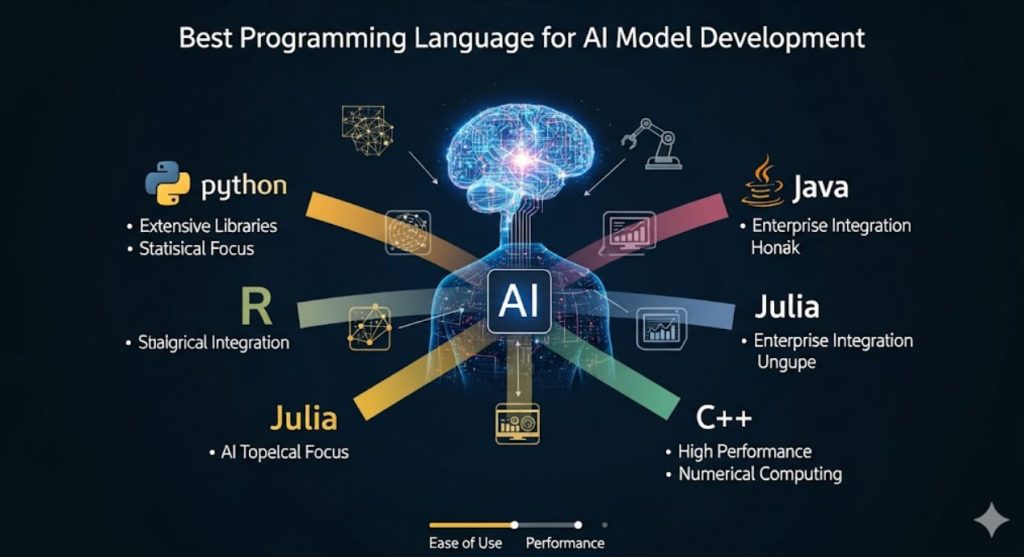
- R: Primarily known as a statistical programming language, R is a favorite among statisticians and data analysts for its powerful statistical modeling capabilities and excellent visualization tools. It’s excellent for exploratory data analysis and traditional machine learning algorithms, though less common for deep learning.
- Julia: A relatively newer language designed for high-performance numerical and scientific computing. Julia aims to combine the ease of use of Python with the speed of C++. Its growing ecosystem and focus on performance make it an interesting language to watch for AI.
- **JavaScript (Node.js): With libraries like TensorFlow.js, JavaScript allows developers to build and run machine learning models directly in web browsers or on Node.js servers. This is particularly useful for web-based AI applications and interactive models.
Making Your Decision: Key Factors to Consider
Choosing the “best” language ultimately depends on your specific goals and circumstances:
- Your Project Type: Are you building a deep learning model for image recognition, an enterprise-grade AI system, a real-time embedded AI solution, or a statistical analysis tool?
- Performance Requirements: Does your application demand absolute maximum speed and efficiency (C++, Julia) or is rapid development and iteration more critical (Python)?
- Ecosystem and Libraries: How important is access to a vast array of pre-built libraries and frameworks? Python excels here.
- Learning Curve and Experience: Are you a beginner or an experienced developer? Python offers an easier entry point.
- Community and Support: A strong community can be invaluable for learning and troubleshooting. Python and Java have massive communities.
- Integration Needs: How will your AI model integrate with other systems or existing infrastructure?
- Deployment Environment: Where will your AI model ultimately run (cloud, edge device, web browser)?
Comparison Table: Best Programming Languages for AI Development
| Language | Ease of Learning | Performance | Library Support | Best Use Cases |
|---|---|---|---|---|
| Python | ⭐⭐⭐⭐⭐ (Beginner Friendly) | ⭐⭐⭐ | ⭐⭐⭐⭐⭐ (TensorFlow, PyTorch, Keras) | AI Research, Machine Learning, NLP |
| R | ⭐⭐⭐ | ⭐⭐⭐ | ⭐⭐⭐⭐ (ggplot2, caret) | Data Science, Statistics, Visualization |
| Java | ⭐⭐⭐ | ⭐⭐⭐⭐ | ⭐⭐⭐ (Weka, Deeplearning4j) | Enterprise AI, Large-scale Apps |
| C++ | ⭐⭐ | ⭐⭐⭐⭐⭐ (Fastest Execution) | ⭐⭐ (Limited AI libraries) | Gaming AI, Robotics, Real-time Systems |
| Julia | ⭐⭐⭐ | ⭐⭐⭐⭐⭐ (Close to C++) | ⭐⭐⭐ (Growing ecosystem) | AI Research, High-performance Computing |
Conclusion
In the dynamic landscape of AI, Python stands out as the most versatile and widely adopted language for AI model development, thanks to its simplicity, extensive libraries, and vibrant community. For high-performance, resource-constrained applications, C++ remains indispensable, often serving as the backbone for Python’s powerful frameworks. Java provides a robust and scalable solution for enterprise-level AI integrations.
Ultimately, there’s no single “best” language; the optimal choice is the one that aligns most effectively with your project’s requirements, your team’s expertise, and your desired development velocity. Many AI professionals even become proficient in multiple languages, leveraging the strengths of each to tackle different aspects of their AI endeavors. So, explore, experiment, and choose the language that empowers you to bring your intelligent creations to life!
FAQs for best programming language for AI model development
A: There is no single “best” language, as the ideal choice depends on your specific goals. However, Python is the most widely used and recommended language for most AI model development tasks, especially for beginners and those focused on research and rapid prototyping. Its vast ecosystem of libraries like TensorFlow, PyTorch, and Scikit-learn makes it incredibly powerful and efficient.
Frequently Asked Questions (FAQs)
Q1: What is the single best programming language for developing AI models?
A: There is no single “best” language, as the ideal choice depends on your specific goals. However, Python is the most widely used and recommended language for most AI model development tasks, especially for beginners and those focused on research and rapid prototyping. Its vast ecosystem of libraries like TensorFlow, PyTorch, and Scikit-learn makes it incredibly powerful and efficient.
Q2: Why is Python so popular for AI and machine learning?
A: Python’s popularity stems from several key factors:
Ease of Use: Its simple, readable syntax makes it easy to learn and code.
Extensive Libraries: A rich collection of specialized libraries for every aspect of AI, from data manipulation (Pandas, NumPy) to deep learning (TensorFlow, PyTorch), significantly speeds up development.
Strong Community: A massive and active community provides abundant resources, tutorials, and support.
Rapid Prototyping: It allows for quick experimentation and iteration, which is crucial in the fast-paced field of AI research.
A: While you can certainly have a successful career by mastering one language, a growing number of AI professionals are becoming proficient in multiple languages. For example, you might use Python for the initial development and training of a model, and then use C++ to optimize and deploy it in a high-performance production environment. The ability to use different tools for different parts of the pipeline can be a significant advantage.
A: It’s not a “bad” idea, but it can be more challenging. Python’s gentle learning curve and focus on high-level concepts allow beginners to grasp the fundamentals of AI and machine learning much faster. Once you have a solid understanding of the core principles, you can then move on to more complex languages like C++ or Java if your career path requires it. Starting with Python is generally a more efficient and rewarding learning path for a newcomer to the field.