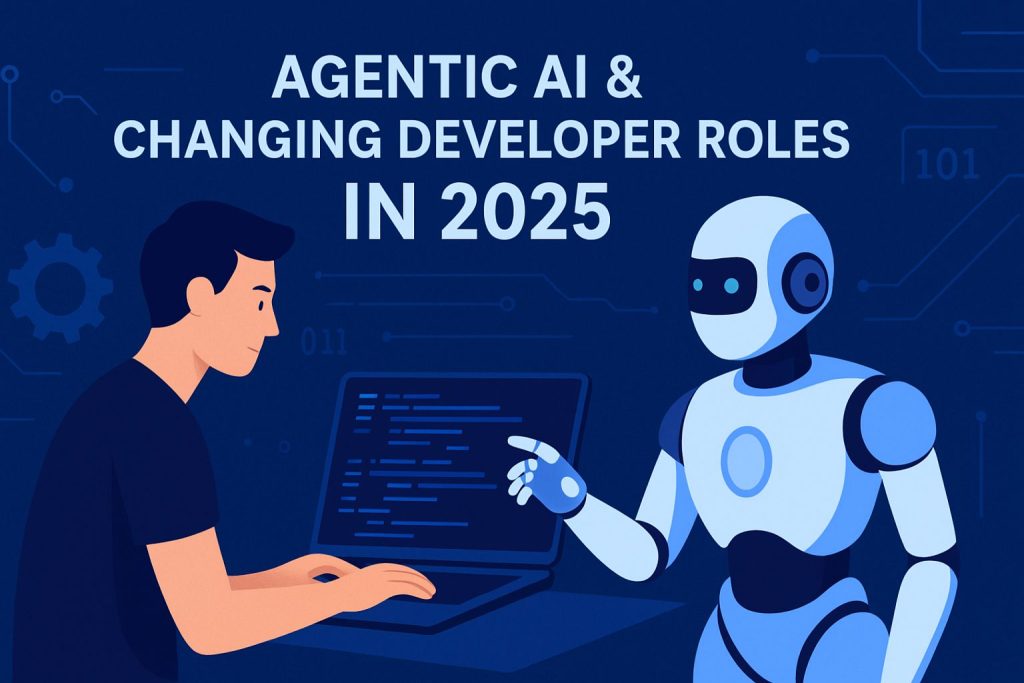
Artificial Intelligence (AI) has been a buzzword for years, but in 2025, we’re seeing a new wave of intelligent systems known as Agentic AI—AI models that don’t just generate outputs but can autonomously act, make decisions, and collaborate with humans in complex workflows.
For developers, this shift is more than just another tool upgrade. It’s a paradigm change that is reshaping traditional coding roles, workflows, and even the career path of software engineers.
So, what is Agentic AI, and how is it changing the role of developers in 2025? Let’s explore in depth.
🤖 1. What Is Agentic AI?
Unlike traditional AI tools that simply respond to inputs (like code autocompletion or bug fixes), Agentic AI refers to systems with agency—the ability to:
- Understand context across different tasks.
- Take initiative without constant human prompting.
- Plan, execute, and adapt workflows dynamically.
- Collaborate with other AI agents and humans.
For example, instead of just suggesting a snippet of code, an Agentic AI could:
- Read your entire project requirements.
- Plan the architecture.
- Write code modules.
- Set up testing pipelines.
- Deploy to production.
👉 Think of Agentic AI as “junior developers with initiative”—AI that doesn’t just follow, but actively contributes.
🌍 2. Why Agentic AI Matters in 2025
Agentic AI is gaining traction because it solves three major challenges developers face today:
🔹 1. Complexity of Software Systems
Modern apps require multiple services, APIs, cloud layers, and integrations. Agentic AI can coordinate these without requiring developers to manually stitch everything together.
🔹 2. Developer Productivity Crisis
Reports show that despite more tools, many developers feel less productive due to tool overload and context-switching. Agentic AI simplifies workflows by handling repetitive, orchestration-heavy tasks.
🔹 3. AI-First Startups
Just like vibe coding, many new startups are embracing AI-first development, where 70–90% of the code is AI-generated. Agentic AI makes this possible by reducing the need for extensive manual oversight in early stages.
🧑💻 3. Changing Developer Roles in the Age of Agentic AI
Agentic AI doesn’t eliminate developers—it evolves their responsibilities. Here’s how roles are shifting:
Code Writers to System Architects
- Developers will design high-level workflows, while AI handles boilerplate and routine tasks.
- Example: Instead of manually writing a REST API, devs define what the API should achieve, and AI generates + tests it.
Debuggers to Reviewers & Curators
- Developers will focus less on fixing syntax bugs and more on reviewing AI-generated code for quality, maintainability, and security.
- Code review becomes critical oversight, not optional.
Executors to AI Managers
- Developers will “manage” fleets of AI agents, ensuring they collaborate effectively.
- This includes task delegation, setting guardrails, and merging outputs.
Builders to Ethical Guardians
- Since AI can write functional but unsafe code, developers must step up as ethical overseers, ensuring systems are secure, fair, and transparent.
👉 In short: Developers are evolving from code producers into strategists, curators, and AI collaborators.
⚡ 4. Benefits of Agentic AI for Developers
When used effectively, Agentic AI can massively improve the developer experience:
🚀 Faster Development Cycles
Projects that once took months can now be launched in weeks, thanks to AI handling the heavy lifting.
🛠️ Automation of Mundane Tasks
Testing, bug fixing, refactoring, and documentation can be automated, freeing developers for creative and strategic work.
🌐 Collaboration Beyond Humans
Multiple AI agents can work alongside human teams, enabling 24/7 progress and higher throughput.
💡 Expanding Creativity
AI can suggest unconventional solutions, helping developers think outside the box.
⚠️ 5. Risks & Challenges of Agentic AI
Of course, with great power comes great responsibility. Agentic AI brings new risks that developers must manage:
❌ Reduced Technical Depth
Over-reliance on AI could make developers less skilled in low-level coding.
❌ Security Vulnerabilities
AI may unintentionally introduce bugs, exploits, or unsafe patterns.
❌ Job Market Fears
Some fear AI will replace developers, especially entry-level coders. In reality, roles will evolve rather than vanish.
❌ Accountability Gaps
When AI makes autonomous decisions, who is responsible for errors—the AI, the developer, or the company?
👉 The challenge: finding the right balance between AI automation and human expertise.
🔑 6. Best Practices for Developers in the Agentic AI Era
To stay relevant and thrive in this new landscape, developers should:
- Master AI Prompting → Learn to guide AI effectively with precise instructions.
- Stay Grounded in Fundamentals → AI can generate code, but developers must understand algorithms, data structures, and architecture.
- Prioritize Security & Ethics → Always review AI-generated code for vulnerabilities.
- Develop AI Management Skills → Learn how to oversee multiple AI agents and merge their outputs.
- Embrace Continuous Learning → Keep updating skills in AI, DevOps, and system design.
👉 Remember: AI won’t replace developers—but developers who know AI will replace those who don’t.
📂 7. Real-World Applications of Agentic AI
- DevOps Automation → AI agents monitor pipelines, fix failing tests, and redeploy services.
- Codebase Maintenance → Autonomous agents refactor outdated codebases for performance.
- Customer Support Bots → AI agents generate fixes in real-time for reported bugs.
- AI-First Startups → Teams use AI to handle 80–90% of the coding, focusing human effort on design and vision.
🔮 8. The Future of Developers in an Agentic AI World
Looking ahead, developer roles will likely evolve into:
- AI-Orchestrators → Coordinating human + AI workflows.
- AI-Security Specialists → Auditing AI code for vulnerabilities.
- AI-Ethics Officers → Ensuring responsible AI usage.
- Hybrid Engineers → Balancing traditional coding with AI-assisted development.
In other words: developers won’t disappear—they’ll become more powerful.
🎯 Final Thoughts
Agentic AI represents the next stage of AI-driven software development. It’s not just about coding faster—it’s about redefining what it means to be a developer.
Instead of typing every line of code, developers in 2025 act as:
- Architects who design the system.
- Curators who review and refine AI outputs.
- Leaders who guide fleets of AI agents.
- Ethical guardians who ensure safety and trustworthiness.
The future belongs to developers who can adapt, collaborate with AI, and embrace their evolving roles.
Agentic AI isn’t the end of developers—it’s their evolution. 🚀